Originally published on the CCIPR Facebook group, October 10, 2026
In Part 1, I traced the shared roots of weed regulation in Alberta and Saskatchewan. In Part 2 I looked at Alberta’s regulatory framework. In this post, we move from the province of the wild rose (Rosa acicularis) to Saskatchewan, home to the western red lily (Lilium philadelphicum).
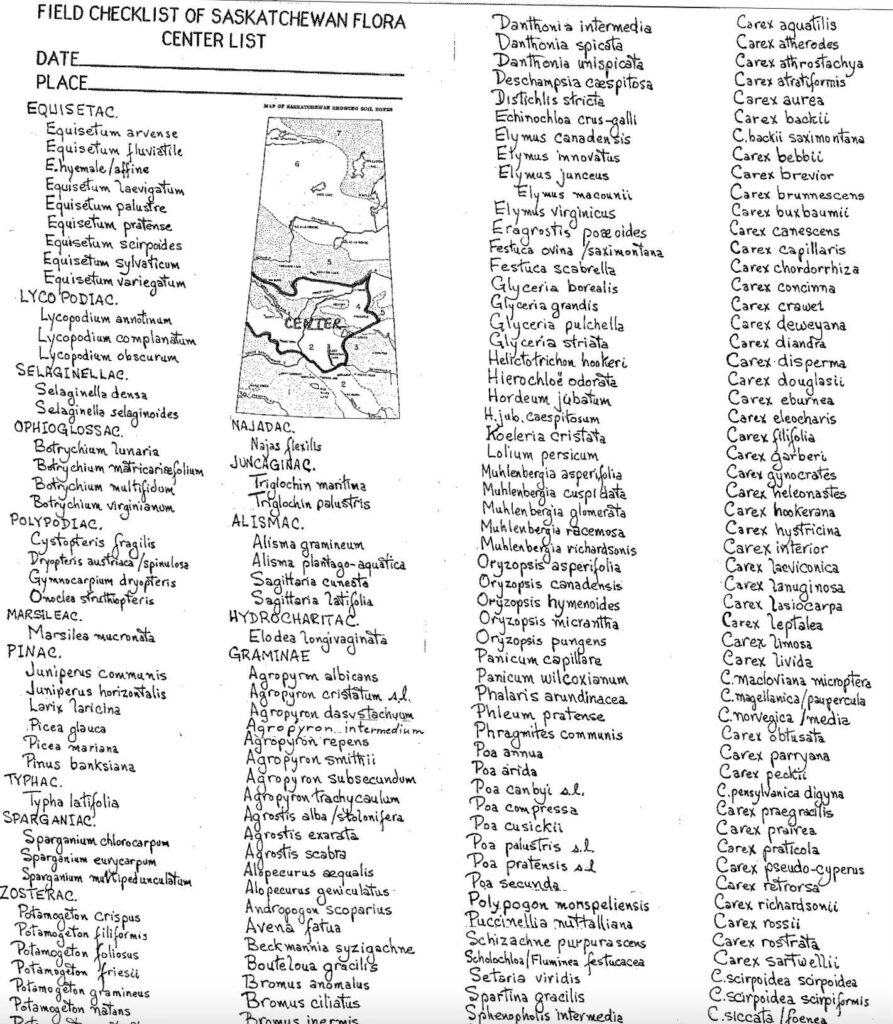
In its early days, the weed ordinance of the North-West Territories was not well received by all. Some “did not appreciate or understand the object” of the legislation and felt it too stringent. In 1899, Dr. James Fletcher, Botanist to the Dominion Government, toured the Territories and addressed agricultural societies promoting the weed ordinance. Fletcher told farmers a weed was “an enemy, an enemy that must be got rid of or it would get rid of the farmer, and got rid of, too, at once, for one year’s seeding meant seven years’ weeding” (Willing, 1900, p. 6).
This framing helped persuade farmers, not always happy with weed inspectors ordering weeds and sometimes crops destroyed, to accept legislation to safeguard agricultural production.
Today’s weed control legislation is still rooted in this framing, but the plants it regulates now include invasive species that harm more than agricultural production. Regulated weeds are considered “a threat to agriculture, human health, or the environment due to their invasive nature or toxic properties” (Government of Saskatchewan, n.d.).
I recommend the video Invasive Weeds in Native Prairie by Clark Brenzil, then Provincial Specialist, Weed Control, with the Government of Saskatchewan (Native Prairie Speaker Series, 2022) for audiovisual learners.
Saskatchewan: three tiers of regulated weeds
Under The Weed Control Act (SS 2010, c W-11.1), Saskatchewan designates weeds by Minister’s Order. The current Order, Designation of Prohibited, Noxious and Nuisance Weeds, was signed on July 3, 2025. That Order lists 94 entries, up from 71, and sorts them into three categories.
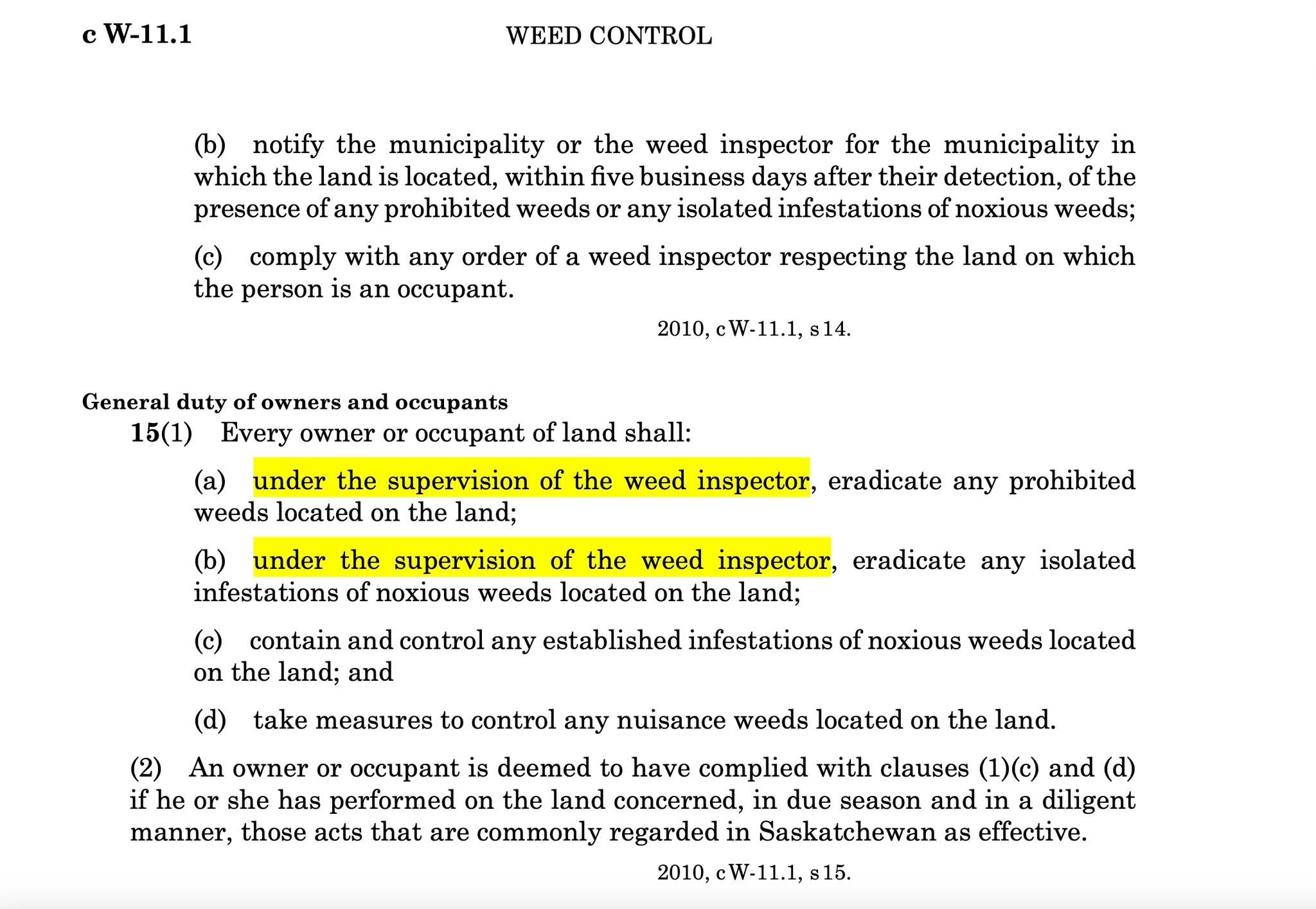
Check out where inspectors don’t exist https://sarm.ca/…/Enforcement-of-The-Weed-Control-Act…
The Act itself defines prohibited, noxious and nuisance weeds only as plants designated as such by the Minister’s Order, so, as in Alberta, the legal definitions are circular. The criteria for each tier come from policy documents rather than from the law.
As in Alberta, prohibited weeds (44) are absent from or rare in the province. Once one is found, however, the landowner must report it to the municipality or its weed inspector within five business days and, under the inspector’s supervision, eradicate it.
Noxious weeds (37) are established in some areas but absent from others. An isolated infestation of five hectares or less must be eradicated under supervision of a weed inspector; an established infestation of more than five hectares must be contained and controlled.
Nuisance weeds (13) are common across the province. Landowners must control them, but enforcement is complaint-driven. (Alberta dropped this nuisance category in 2010; Saskatchewan has kept it.)
Some of the ornamental and garden-trade or former garden-trade species on Saskatchewan’s list, with notes on how Alberta treats them:
Prohibited:
- balsam, Himalayan (Impatiens glandulifera)
- barberry, common (Berberis vulgaris)
- blueweed (Echium vulgare) [noxious in Alberta]
- chervil, wild (Anthriscus sylvestris) [not regulated in Alberta]
- common reed, European (Phragmites australis subsp. australis)
- crown vetch (Securigera varia) [not regulated in Alberta]
- floating heart, yellow (Nymphoides peltata) [prohibited in Alberta under fisheries legislation]
- hawkweed, meadow and orange (Hieracium caespitosum, H. aurantiacum) [noxious in Alberta, as Pilosella]
- hogweed, giant (Heracleum mantegazzianum)
- knapweeds, several (Centaurea spp.) [noxious in Alberta]
- knotweed, Japanese and giant (listed as Polygonum cuspidatum and P. sachalinense) [hybrid not listed; Alberta lists all three]
- mustard, garlic (Alliaria petiolata)
- rush, flowering (Butomus umbellatus)
- saltcedar (Tamarix spp.)
- scabious, field (Knautia arvensis) [noxious in Alberta]
- teasels (Dipsacus spp.) [not regulated in Alberta]
- toadflax, Dalmatian (Linaria dalmatica) [noxious in Alberta]
Noxious:
- absinthe (Artemisia absinthium) [not regulated in Alberta]
- baby’s-breath (Gypsophila paniculata)
- bellflower, creeping (Campanula rapunculoides) [removed from Alberta’s list in 2026]
- buckthorn, European (Rhamnus cathartica) [prohibited noxious in Alberta]
- daisy, oxeye (Leucanthemum vulgare)
- dame’s rocket (Hesperis matronalis)
- kochia (listed as Kochia scoparia; now Bassia scoparia) [not regulated in Alberta]
- loosestrife, purple (Lythrum spp.) [the whole genus; Alberta lists only L. salicaria]
- mullein, common (Verbascum thapsus)
- spurge, cypress (Euphorbia cyparissias) [an “Alert” species in Alberta, but not regulated]
- tansy, common (Tanacetum vulgare)
- toadflax, yellow (Linaria vulgaris)
Nuisance weeds include widespread plants like dandelion (Taraxacum officinale), quack grass (Elytrigia repens), Canada thistle (Cirsium arvense), nodding thistle (Carduus nutans), the sow-thistles (Sonchus spp.) and yellow goat’s-beard (Tragopogon dubius). The list also includes some native plants like foxtail barley (Hordeum jubatum) and poverty weed (Iva axillaris).
The Order uses some outdated names, including Polygonum for the knotweeds and Hieracium for certain hawkweeds, and contains several misspellings. Names matter legally and for cross-jurisdictional comparisons: itadori (Reynoutria japonica) is listed as Japanese knotweed (Polygonum cuspidatum).
What changed in 2025
The 2025 Order added 18 species to the prohibited list, including Himalayan balsam (Impatiens glandulifera), Japanese and giant knotweed, teasels (Dipsacus spp.), crown vetch (Securigera varia), European common reed (Phragmites australis subsp. australis) and bighead knapweed (Centaurea macrocephala), among others. The Order also moved down a tier plants that have become more widespread. Hound’s-tongue (Cynoglossum officinale) went from prohibited to noxious, and six species, including several thistles, went from noxious to nuisance. At the same time, four new species were added as noxious: creeping bellflower (Campanula rapunculoides), woolly burdock (Arctium tomentosum), black medick (Medicago lupulina) and common mullein (Verbascum thapsus).
The review behind the 2025 Order was the first since 2010, although the list was meant to be reviewed every five years. In 2023, a proposed list was presented for public review (Brenzil, 2023).
Following that process, the Ministry reported: “After careful consideration of the feedback received during the consultation process, adjustments were made to the proposed Minister’s Order which includes keeping kochia as a noxious weed, adding creeping bellflower as a noxious weed and keeping four aquatic weeds (yellow floating heart, curly-leaved pondweed, flowering rush and Eurasian water-milfoil) that were initially proposed to be removed, on the prohibited weeds list” (Dokken, 2025).
There is no publicly accessible weed risk assessment database for comparative purposes. Screening tools have been tested for the region: a University of Saskatchewan thesis, for example, evaluated a modified weed risk assessment for the prairie provinces (Wang, 2016). I return to screening tools in Part 4.
Aquatic invasive plants
Six aquatic or semi-aquatic plants are regulated under The Weed Control Act: Eurasian water-milfoil, curly-leaved pondweed, yellow floating heart, flowering rush and European common reed as prohibited weeds, and purple loosestrife as a noxious weed.
The Fisheries Regulations prohibit importing, possessing, transporting or selling listed aquatic invasive species, but all 24 listed species are animals. The Fisheries (Saskatchewan) Act, 2020 does allow plants to be listed, but so far none have been.
Several plants sold through the aquarium and water-garden trades, such as hydrilla, Brazilian elodea, water soldier and European water chestnut, have no provincial regulation in Saskatchewan. Alberta prohibits all four under its fisheries legislation, and Manitoba prohibits possessing, importing, releasing or transporting them under The Water Protection Act, s. 29.4(1), and lists them in its Aquatic Invasive Species Regulation, along with 17 others.
Enforcement
In Saskatchewan, appointing a weed inspector is largely at each municipality’s discretion. A municipality, rural or urban, “may” appoint one, and must do so if ten voters petition for it. In Alberta, by contrast, appointments are obligatory.
The law tells landowners to get rid of prohibited weeds under the supervision of a weed inspector. It is unclear what happens in a municipality without an inspector. The rule still exists on paper, but no one is responsible for making sure it is followed.
Saskatchewan’s invasive species framework
Saskatchewan’s Framework for the Prevention and Management of Invasive Species (released November 10, 2022) sets out four pillars: prevent entry, prevent establishment, respond to establishment, and adapt to established species “when removal is no longer practical.” Under prevention, it commits to “critical pathways analysis” and to identifying “legislative and regulatory gaps,” but it does not name any specific pathway. The horticultural, aquarium and water-garden trades are not mentioned.
Education, outreach and reporting
Government and agricultural resources
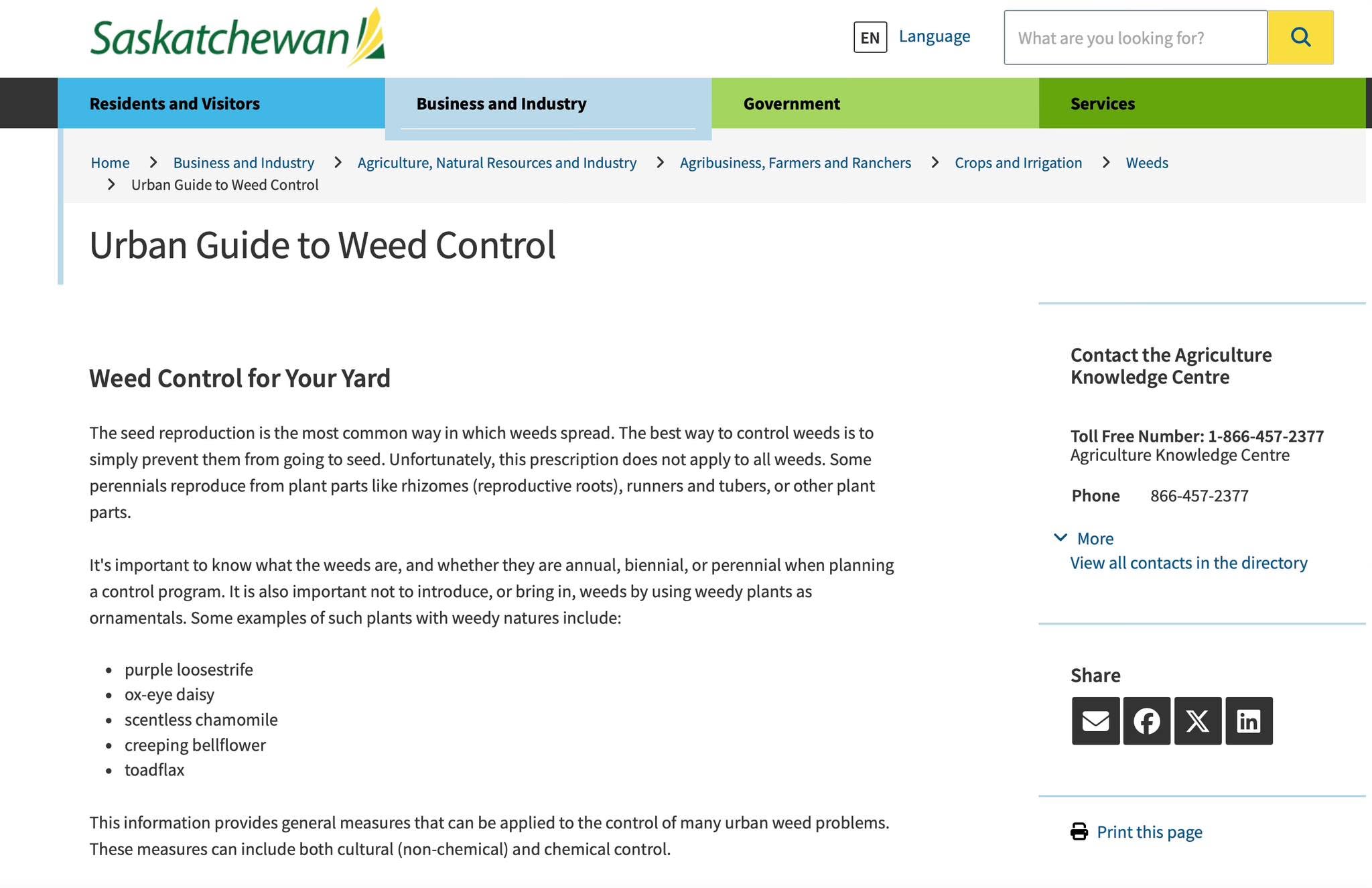
The Saskatchewan government provides public information about weeds, but relatively little attention is given to invasive plants as a biodiversity concern. Much of the material focuses on preventing agricultural weeds. The government’s weed resources include an Urban Guide to Weed Control, but the word invasive appears only once, near the bottom of the page, where prohibited and noxious weeds are described as a threat “due to their invasive nature or toxic properties.” Here invasive describes a trait, how aggressively a plant spreads, rather than a non-native species introduced by people that causes harm.
The provincial Ministry of Environment’s Facebook page promotes the “Clean, Drain, Dry” and “Don’t Let It Loose” campaigns, which focus mainly on aquatic invasive animals. The page occasionally features a noxious weed, but discussion of invasive plants seems limited.
Agricultural organizations provide resources for farming audiences. The Saskatchewan Forage Council, for instance, offers information on common range plants on its Resources page. However, its discussion of riparian areas describes both “native invaders” and exotic invaders in the context of overgrazing. Here, the language of invasion describes plants that spread under overgrazing, whether native or not, rather than distinguishing non-native plants that pose a risk to ecosystems.
Mixed messages for gardeners
The broad use of invasive to describe plants with aggressive growth habits also appears in Gardening at USask, a university-based gardening advice website (gardening.usask.ca). Although the site actively promotes gardening with native plants, its messaging about invasive plants is mixed.
One page states that “some plants can be invasive under certain conditions, but most are not,” using the term in a discussion of annuals and perennials (USask, n.d.). The site recommends lily-of-the-valley (Convallaria majalis) and, more surprisingly, wild chervil (Anthriscus sylvestris), a prohibited plant in Saskatchewan. It describes the dark-leaved form ‘Raven’s Wing’ as “outstanding” (USask, 2021).
Yet the site’s Creating Biodiversity in Your Yard page advises readers: “Do not grow invasive or aggressive plants that have the potential to take over your garden and spread throughout your community.” It directs readers to saskinvasives.ca for a list of regulated weeds.
Taken together, these sources suggest that in Saskatchewan’s public messaging, weeds and invasive plants are not clearly distinguished. Invasive is used to mean a plant that spreads aggressively, whether native or not. What is largely missing is the harm that sets invasive plants apart: non-native species, introduced by people, that escape cultivation and displace native flora. Without that distinction, a gardener or grower has little reason to see invasive plants as different from any other weed or vigorous perennial.
Public education and organizational capacity
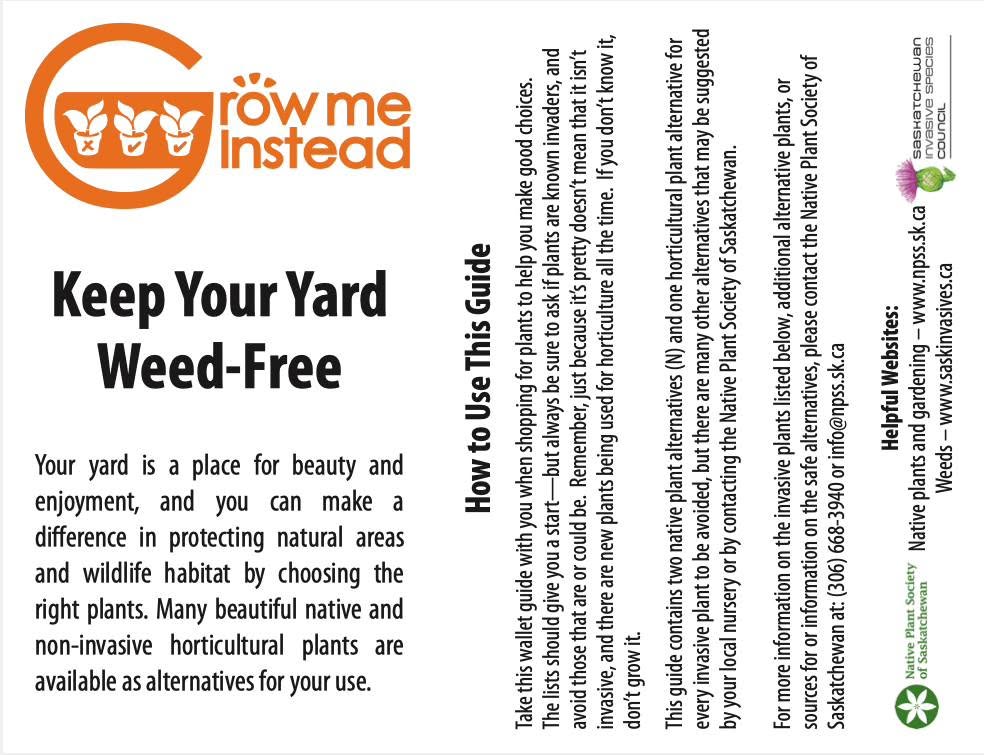
The Saskatchewan Invasive Species Council (SISC), in collaboration with the Native Plant Society of Saskatchewan, has developed Your Guide to Weed Free Plant Shopping: Grow Me Instead Wallet Card. Here the public messaging is clear: to protect natural areas and wildlife habitat, choose native and non-invasive horticultural plants. The Native Plant Society also provides a range of additional resources and maintains an active public education program.
SISC’s current public-facing resources appear more limited. Its website has numerous “coming soon” entries, although it does provide fact sheets for many regulated species. While the Native Plant Society has paid administrative support, SISC lists no staff. This raises questions about the organizational capacity available to support invasive species education and outreach across the province.
I should note, an invasive species guidebook is also available through the Notice Nature program a North Saskatchewan River Basin initiative.
Reporting
Residents are encouraged to report invasive species sightings through iNaturalist, local municipalities, or the Agriculture Knowledge Centre at 1-866-457-2377. The province also offers the iMapInvasives app for mapping and sharing observations.
Biodiversity Saskatchewan reports species distributions and tracks changes. This is particularly important for species at risk, but it is also useful for monitoring plant introductions (Saskatchewan Conservation Data Centre, https://www.biodiversity.sk.ca/SppList.htm).
Looking ahead
This post has described how Saskatchewan regulates invasive plants: the three tiers of regulated weeds, the changes made in 2025, the gap in aquatic plant regulation, how enforcement works, and the resources available to the public. In Part 4, I step back to ask a broader question: are these laws, and the resources behind them, preventing invasive plants from arriving and spreading?
Sources
Legislation
- Saskatchewan. (2010). The Weed Control Act, SS 2010, c W-11.1. https://pubsaskdev.blob.core.windows.net/…/38393/W11-1.pdf
- Saskatchewan. (2025, July 3). Minister’s Order: Designation of Prohibited, Noxious and Nuisance Weeds in Accordance with The Weed Control Act. The Saskatchewan Gazette, Part I, July 18, 2025, pp. 13-16.
- Saskatchewan. (2010, December 1). Designation of Prohibited, Noxious and Nuisance Weeds. Native Plant Society of Saskatchewan copy. https://www.npss.sk.ca/…/The_Weed_Control_Act_-_Plant…
- Saskatchewan. (2020). The Fisheries (Saskatchewan) Act, 2020, SS 2020, c 23. https://pubsaskdev.blob.core.windows.net/…/Chap-23-2020…
- Saskatchewan. The Fisheries Regulations, RRS c F-16.1 Reg 1 (as amended to SR 29/2026). https://pubsaskdev.blob.core.windows.net/…/F16-1r1.pdf
- Manitoba. The Water Protection Act, CCSM c W65, s. 29.4(1).
- Manitoba. Aquatic Invasive Species Regulation, Man Reg 173/2015, under The Water Protection Act, CCSM c W65. https://web2.gov.mb.ca/laws/regs/current/173-2015.php
Other sources
- Brenzil, C. (2022). Invasive Weeds in Native Prairie. Native Prairie Speaker Series. https://www.youtube.com/watch?v=iK1C6mpVp54
- Saskatchewan Forage Council. (n.d.). Resources. https://www.saskforage.ca/resources
- Government of Saskatchewan. (2022, November 10). Framework for the prevention and management of invasive species in Saskatchewan. Announced in “Saskatchewan releases invasive species framework” [News release]. https://www.saskatchewan.ca/…/saskatchewan-releases…
- Willing, T. N. (1900). Noxious weeds and how to destroy them. Regina. See “The Farmers’ Enemy,” in Addresses on Noxious Weeds at Agricultural Society Meetings in 1899, p. 6. HathiTrust. https://catalog.hathitrust.org/Record/100315081
- Brenzil, C. (2023, January 10). Proposed review of Minister’s Order designating prohibited, noxious and nuisance weeds (weed list) for The Weed Control Act [Presentation]. Weed Inspector Training, Saskatchewan Association of Rural Municipalities. https://sarm.ca/…/WCA_Ministers_Order_Review-WITC2023.pdf
- Dokken, F. (2025, July 29). [Letter to stakeholders on the updated Minister’s Order]. Saskatchewan Ministry of Agriculture. Posted by the RM of Pense No. 160. https://www.pense160.ca/municipalservices/weed-control
- Government of Saskatchewan. (n.d.). Urban guide to weed control. https://www.saskatchewan.ca/…/urban-guide-to-weed-control
- University of Saskatchewan. (2021, May 2). Cow parsnip or wild chervil. Gardening at USask. https://gardening.usask.ca/…/cow-parsnip-or-wild…
- Wang, H. (2016). Assessing the potential invasiveness of Chinese plant species in Canadian prairie provinces [Master’s thesis, University of Saskatchewan]. HARVEST. https://harvest.usask.ca/…/73aed780-5b46-4dea…/content
- Saskatchewan Invasive Species Council. (n.d.). Who we are and Board of directors. https://www.saskinvasives.ca/who-we-are; https://www.saskinvasives.ca/board-of-directors
- Native Plant Society of Saskatchewan. (n.d.). Info and resources. https://www.npss.sk.ca/info-resources
- Saskatchewan Invasive Species Council and Native Plant Society of Saskatchewan. (n.d.). Your guide to weed free plant shopping: Grow me instead wallet card. https://www.npss.sk.ca/…/grow-me-instead-wallet-card.pdf
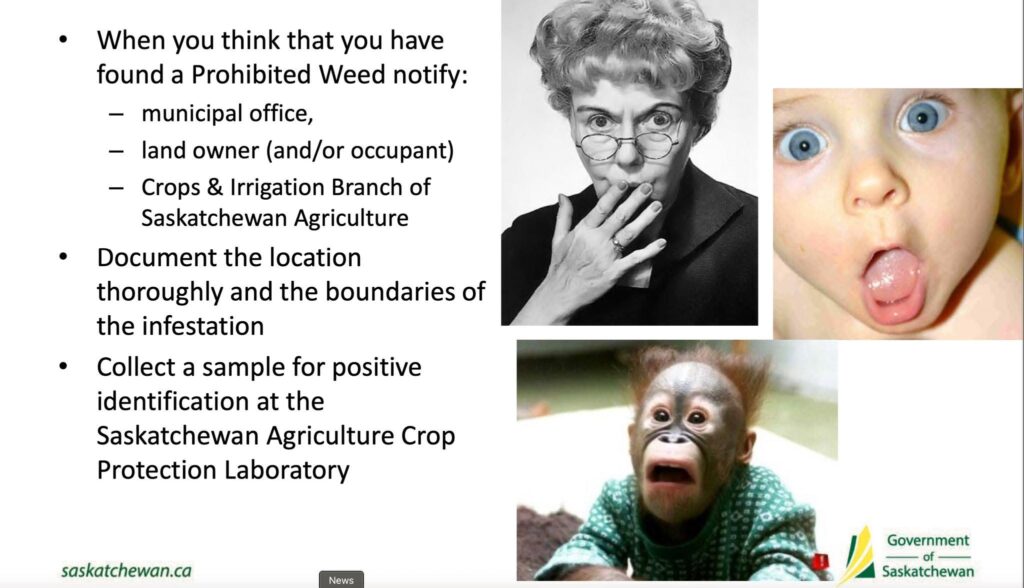
I do love this slide from Enforcement Processes of The Weed Control Act
Cory Jacob, PAg, Acting Provincial Specialist – Weed Control Saskatchewan Ministry of Agriculture
https://sarm.ca/wp-content/uploads/2025/02/Enforcement-of-The-Weed-Control-Act-Presentation-PDF.pdf