Originally published on the CCIPR Facebook Group, October 2, 2026
In Part 1, I traced some of the shared history of weed regulation in Alberta and Saskatchewan. This post looks at how Alberta regulates invasive plants today.
Alberta: two tiers of regulated weeds
Alberta’s Weed Control Act (SA 2008, c W-5.1) allows the Minister of Agriculture and Irrigation to designate a plant as a prohibited noxious or noxious weed across the province through the Weed Control Regulation (Alta Reg 19/2010). The Act also allows local authorities to designate plants as weeds within a municipality. The species list was most recently revised effective January 28, 2026. The Alberta Invasive Species Council (AISC) hosted a good webinar explaining the update, Invasive Plants in Alberta: Understanding the New Weed Regulations. https://www.youtube.com/watch?v=mg6vNMyXfZY&t=2s
On its “Provincially regulated weeds” page, the Alberta government describes a noxious weed as one that poses significant economic, social or ecological risks. The legislation itself sets no such criteria; it simply gives the Minister authority to designate any plant. Contrast that with Ontario’s Invasive Species Act, 2015, which requires that a regulated invasive species be non-native to Ontario and harming, or likely to harm, the natural environment.
The 2026 list is the product of a review process. A Weed Review Committee of Alberta Agriculture and Irrigation staff, regional representatives of the Association of Alberta Agricultural Fieldmen, urban municipalities, and staff from other provincial departments assessed potential species with a “Weed Risk Tool” covering economic, environmental, human and animal health, and market impacts. Following stakeholder input, the Minister made the final decisions in 2025 (Agricultural Service Boards, 2024; AISC webinar).
Under Alberta’s two tiers, landowners must destroy prohibited noxious weeds and control noxious weeds.
Prohibited noxious weeds are high-priority species not yet well established in the province. A person is required to destroy a prohibited noxious weed on land they own or occupy.
Noxious weeds are established in Alberta. A person is still legally required to control them, which the Act defines as inhibiting their growth or spread, or destroying them.
While the legal obligation to remove or control invasive plants is clear, practical decisions about inspection, enforcement and organized control rest largely with local authorities. The Alberta government describes the legislation as supporting prevention and containment. For noxious weeds, it states that a local authority may conduct control programs where it “feels” a weed may have significant ecological or economic impact within its municipality (ABGov, Provincially regulated weeds).
This leaves considerable scope for local variation in how actively noxious weeds are managed.
Enforcement
Each local authority must appoint inspectors to enforce and monitor compliance with the Act within its municipality (s. 7(1)); the Minister can instead direct a provincially appointed inspector to act on a municipality’s behalf (s. 7(2)). Agricultural fieldmen under the Agricultural Service Board Act are inspectors by virtue of their office. Fines are up to $5,000, and up to $1,000 a day for failing to comply with a Minister’s notice.
Alberta’s 2026 regulatory update
Effective January 28, 2026, Alberta lists 51 prohibited noxious and 44 noxious weeds, up from 46 and 29. The amendment added 17 species as prohibited noxious and 5 hawkweeds as noxious, moved 12 species, mostly knapweeds and hawkweeds, from prohibited noxious to noxious, and removed creeping bellflower (Campanula rapunculoides) and perennial sow-thistle (Sonchus arvensis).
Importantly, hybrids of regulated species are now regulated too, so inspectors no longer need to tell a regulated species from its hybrids in the field.
There is an Alberta Weed Compendium (2023) that provides risk assessments for the 75 species regulated before the 2026 update. I have not seen assessments for the species added in 2026, nor am I aware of a public database of risk assessments for other plants of potential concern.
The removal of creeping bellflower (Campanula rapunculoides) drew strong objections during the review, according to provincial staff.
Staff explained that creeping bellflower had continued to spread since first being regulated in 2010. They suggested that this meant regulation had not been effective. At the same time they suggested public awareness and education was proving somewhat effective.
However, continued spread does not, by itself, demonstrate that regulation failed. We do not know how far creeping bellflower might have spread in the absence of regulation, nor how consistently the legislation was enforced across municipalities. Alberta’s system leaves considerable discretion to local authorities, and levels of inspection and control may have varied from one community to another.
It is also likely that regulatory designation strengthened education and outreach efforts by formally recognizing creeping bellflower as a plant of significant concern.
While creeping bellflower is no longer regulated, the regulated lists do include many familiar plants associated with horticulture, landscaping or ornamental plantings, for example:
Prohibited noxious:
- balsam, Himalayan (Impatiens glandulifera)
- barberry, common (Berberis vulgaris)
- buckthorn, common (Rhamnus cathartica)
- hogweed, giant (Heracleum mantegazzianum)
- iris, pale yellow (Iris pseudacorus)
- knotweeds, Japanese, giant and hybrid (Reynoutria spp.)
- loosestrife, purple (Lythrum salicaria)
- mustard, garlic (Alliaria petiolata)
- olive, autumn (Elaeagnus umbellata)
- phragmites, invasive (Phragmites australis)
- Queen Anne’s lace (Daucus carota)
- rush, flowering (Butomus umbellatus)
- St. John’s-wort, common (Hypericum perforatum)
- swallowwort, black and pale (Vincetoxicum nigrum and V. rossicum)
- tamarisks (Tamarix spp.)
Noxious:
- baby’s-breath, common (Gypsophila paniculata)
- clematis, yellow (Clematis tangutica) [still sold through nurseries, according to provincial staff]
- daisy, oxeye (Leucanthemum vulgare)
- dame’s rocket (Hesperis matronalis)
- hound’s-tongue (Cynoglossum officinale)
- knapweeds, several (Centaurea spp., including C. macrocephala)
- mullein, common (Verbascum thapsus)
- scabious, field (Knautia arvensis)
- tansy, common (Tanacetum vulgare)
- toadflax, Dalmatian and yellow (Linaria dalmatica and L. vulgaris)
The revisions from the earlier list indicate that a plant’s legal status can shift with changes in its distribution and the cost of managing it.
Alberta had already dropped its nuisance category in 2010. As Paul Laflamme, head of Alberta Agriculture and Rural Development’s Pest Surveillance Branch, explained: “The main reason we got rid of the nuisance list was that in our old Act there was nothing you could do on a nuisance weed. You couldn’t issue a notice on a nuisance weed. So it was just a list of very, very common weeds” (Top Crop Manager, 2011).
Aquatic invasive plants: a different regulatory approach
Some invasive aquatic plants are regulated under Alberta’s Weed Control Act, but Alberta regulates more under the Fisheries (Alberta) Act (RSA 2000, c F-16). Amendments in 2015 prohibit possessing or importing listed invasive organisms, or placing them in water, which in effect bars their sale. Penalties reach $100,000 and/or a year in prison for individuals. The Act’s schedule lists 16 invasive aquatic plants:
- balsam, Himalayan (Impatiens glandulifera)
- curly-leaf pondweed (Potamogeton crispus)
- elodea, Brazilian (Egeria densa)
- fanwort (Cabomba caroliniana)
- floating-heart, yellow (Nymphoides peltata)
- flowering rush (Butomus umbellatus)
- frog-bit, European (Hydrocharis morsus-ranae)
- hydrilla (Hydrilla verticillata)
- iris, yellow flag (Iris pseudacorus)
- loosestrife, purple (Lythrum salicaria)
- phragmites (Phragmites australis)
- salvinia, giant (Salvinia molesta)
- water chestnut, European (Trapa natans)
- water soldier (Stratiotes aloides)
- watermilfoil, Eurasian and variable-leaf (Myriophyllum spicatum and M. heterophyllum)
Several invasive aquatic plants appear in both Alberta’s weed legislation and its fisheries legislation. The fisheries legislation effectively prevents sale and is a direct pathway-prevention tool, since many aquatic invasive plants have historically been spread through the aquarium and water-garden trades. The Weed Control Act imposes a different obligation: control once the plant is growing.
Education and outreach
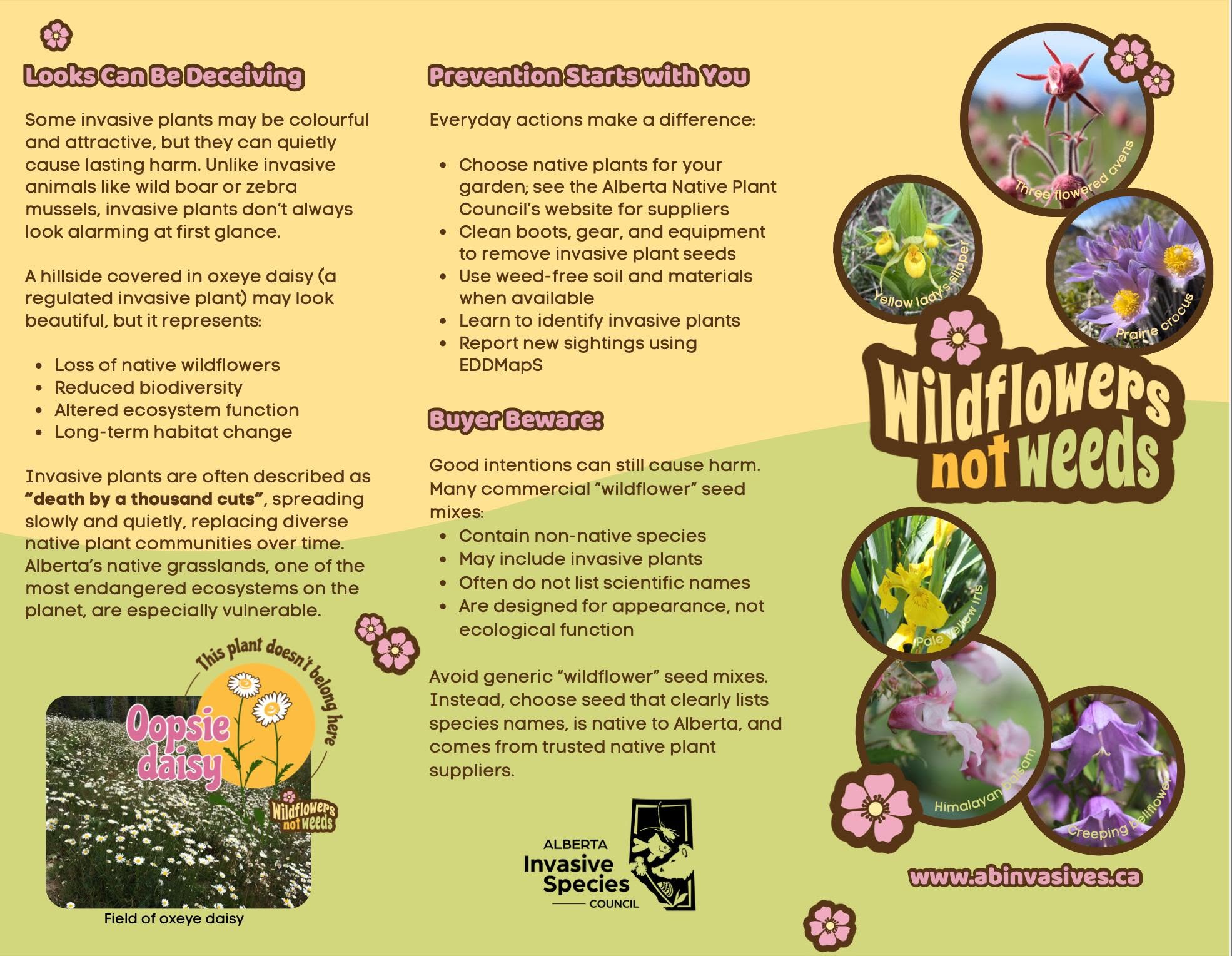
Alberta’s outreach includes provincial identification guides and the Alberta Invasive Species Council’s gardener brochures, Wildflowers Not Weeds and Grow Me Instead (PlantWise), which steer gardeners toward non-invasive alternatives and away from generic wildflower seed mixes. Municipal agricultural services also publish updates, such as Kneehill County’s summary of the 2026 changes.
The Alberta Native Plant Council is also active, and the Grow Me Instead brochure refers gardeners to its resources, including its Guidelines for Purchase and Use of Wildflower Seed Mixes.
Reporting and tracking
Albertans are urged to report suspected invasive plants with the EDDMapS Alberta app (Early Detection and Distribution Mapping System), which also supports AISC’s volunteer Spotters Network.
Agricultural fieldmen, county land managers and invasive species professionals can use EDDMapS Pro for structured surveys.
Questions about regulated weeds can go to the province at 310-FARM.
Legal and resource limitations
Alberta’s regulatory system has evolved beyond traditional agricultural weed control to try to reduce the growing harms that introduced invasive plants cause in riparian and natural areas.
It is interesting, however, that the horticultural pathway is rarely mentioned explicitly in public-facing documents such as the Alberta Invasive Alien Species Management Framework (2010). It is not clear how much “market” factors and landscape industry feedback play in risk assessment scoring, but several horticultural plants recognized as high risk remain unregulated.
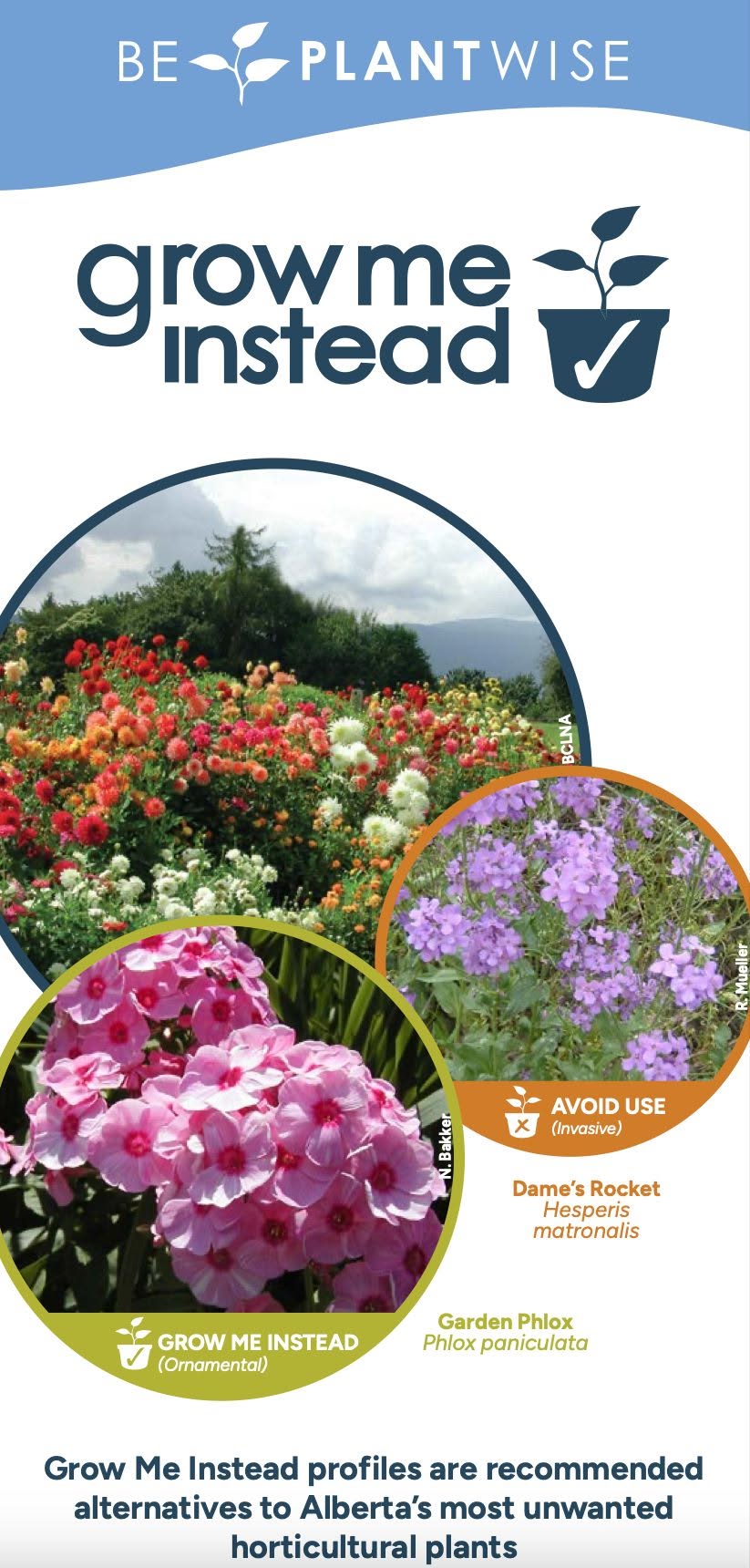
In the Grow Me Instead (PlantWise) brochure (2026), the Alberta Invasive Species Council issues an Alert for these invasive plants:
- bachelor’s buttons and mountain star-thistle (Centaurea cyanus and C. montana) [many other Centaurea species are regulated]
- broom, Scotch (Cytisus scoparius) [regulated in several U.S. states, including Montana]
- caragana, common (Caragana arborescens) [already established in some natural areas; Calgary is removing it from several parks]
- goutweed, bishop’s (Aegopodium podagraria)
- lamium (Lamium spp.)
- lily of the valley (Convallaria majalis)
- olive, Russian (Elaeagnus angustifolia) [in my view a more popular ornamental than the regulated autumn olive, and considered high risk in other jurisdictions]
- spurge, cypress (Euphorbia cyparissias)
It would be helpful to see the risk assessments and to understand why these are not regulated.
During the AISC webinar on the changes, provincial staff were asked why garden centres were allowed to continue selling invasive plants. They said that is left to municipalities to check and act.
One presenter suggested that creeping bellflower continued to appear in some wildflower seed mixes. They also said they would like to see seed packets labelled, calling it a gap worth closing.
Final thought
According to Alberta’s 2020 General Status assessment, published in 2022, 350 of the province’s 1,965 vascular plant species were non-native introduced plants. Of these, 49 were regulated under the Weed Control Act. With climate change, the number of garden plants that become established outside cultivation is expected to grow, but it is not clear how prepared Alberta is to stem this flow.
The Weed Control Act focuses on prevention through early detection and rapid response, but that prevention begins once a plant is already growing in Alberta. Unlike the Fisheries Act, the legislation does not explicitly prohibit importation, sale, possession or movement.
There is a wide middle ground between requiring eradication and allowing continued distribution.
The question is not simply which plants should be controlled. It is also where in the pathway should regulation intervene?
Sources
Legislation
- Alberta. (2000). Fisheries (Alberta) Act, RSA 2000, c F-16. https://kings-printer.alberta.ca/1266.cfm?page=F16.cfm…
- Alberta. (2008). Weed Control Act, SA 2008, c W-5.1. https://kings-printer.alberta.ca/1266.cfm?page=W05P1.cfm…
- Alberta. (2010). Weed Control Regulation, Alta Reg 19/2010. https://open.alberta.ca/publications/2010_019
- Ontario. (2015). Invasive Species Act, 2015, SO 2015, c 22. https://www.ontario.ca/laws/statute/s15022
Government and organization publications
- Agricultural Service Boards. (2024, April 12). Changes to the weed regulation: Survey open for AAAF. https://agriculturalserviceboards.com/…/changes-to-the…/
- Alberta Invasive Species Council. (2026). Grow me instead: Be PlantWise (updated Spring 2026). https://abinvasives.ca/…/GMI-PlantWise-Brochure-2026…
- Alberta Invasive Species Council. (2026). Wildflowers not weeds [Brochure]. https://abinvasives.ca/…/05/WNW-Trifold-Brochure-Web.pdf
- Alberta Invasive Species Council. (2026, June 3). Invasive plants in Alberta: Understanding the new weed regulations [Webinar]. YouTube. https://www.youtube.com/watch?v=mg6vNMyXfZY
- Alberta Invasive Species Council. (n.d.). EDDMapS Pro. https://abinvasives.ca/eddmaps-pro/
- Government of Alberta. (2010). Alberta invasive alien species management framework. https://www1.agric.gov.ab.ca/…/prm13262/%24file/frame.pdf
- Government of Alberta. (2022). Plants, land and wetlands indicators: Vascular plants. https://www.alberta.ca/plants-land-and-wetlands…
- Government of Alberta. (2023). Alberta weed compendium. Alberta Agriculture and Irrigation. https://open.alberta.ca/publications/alberta-weed-compendium
- Government of Alberta. (n.d.). Alberta invasive plant identification guide: Prohibited noxious and noxious. https://open.alberta.ca/publications/6740590 [add date]
- Government of Alberta. (n.d.). Provincially regulated weeds. Retrieved October 2026. https://www.alberta.ca/provincially-regulated-weeds
- Kneehill County. (2026, May 29). Updates to Alberta’s Weed Control Regulation. https://kneehillcounty.com/m/newsflash/Home/Detail/814
- Rocky View County. (2026). Alberta Weed Control Regulation: Key updates for 2026. https://www.rockyview.ca/…/alberta-weed-control…
- Top Crop Manager. (2011, November 21). A timely update on the Weed Acts. https://www.topcropmanager.com/a-timely-update-on-the…/