Originally published on the CCIPR’s Facebook group, October 26, 2026
In 2022, Canada pledged to prevent the introduction and spread of invasive species by managing their pathways. For invasive plants, the main pathway is the global horticultural trade. Yet governments at international, national and provincial levels have been reluctant to restrict sales or modernize legislation to address the problem at its source.
The BC picture is a microcosm of the national and international problem.
SUMMARY
- BC’s weed law focuses on control, not prevention. The more a plant spreads, the costlier a listing becomes, so widespread invaders such as Scotch broom go unlisted and others slide down or off the lists.
- Municipal powers are uneven and hard to interpret, and they don’t reach Vancouver, rural areas or the Gulf Islands. The result is a patchwork.
- Local governments have asked the Province for action since 2008. In 2023 the Province called its weed law “antiquated,” but no new law has followed.
- The Province already has a science-based priority list. High-risk plants on it should not be sold or intentionally spread.
- Regional lists create confusion and leave gaps: nurseries sell plants wherever they can grow.
- What would help: a legally binding, risk-based list of plants that may not be sold, separate from the duty to control, backed by national action on a trade that crosses borders.
THE CONTROL TRAP
Laws that require control can trap governments in a cycle. The more a plant spreads, the more it costs to control, and the harder it becomes to keep it on the list. Over time, plants slide down the lists, from province-wide to regional, or off them altogether. They aren’t any less harmful; control just no longer seems achievable or affordable. Some widespread invaders are never listed at all for this reason. Meanwhile, nothing in provincial law stops them from being sold.
Like many provincial weed laws, BC’s focuses on control, which pushes action to the lowest level. In BC, the land occupier must cut, pull or spray regulated weeds. But BC’s law also makes the Province itself an occupier with a duty to control. If it names the problem, it can’t ignore it.
Look at BC’s noxious weed list. Some of the most familiar invaders in southwest BC are missing: Scotch broom, English ivy, Himalayan blackberry and spurge laurel. Why?
Under BC’s Weed Control Act, listing a widespread plant means paying to control it on public land, with taxpayers footing the bill.
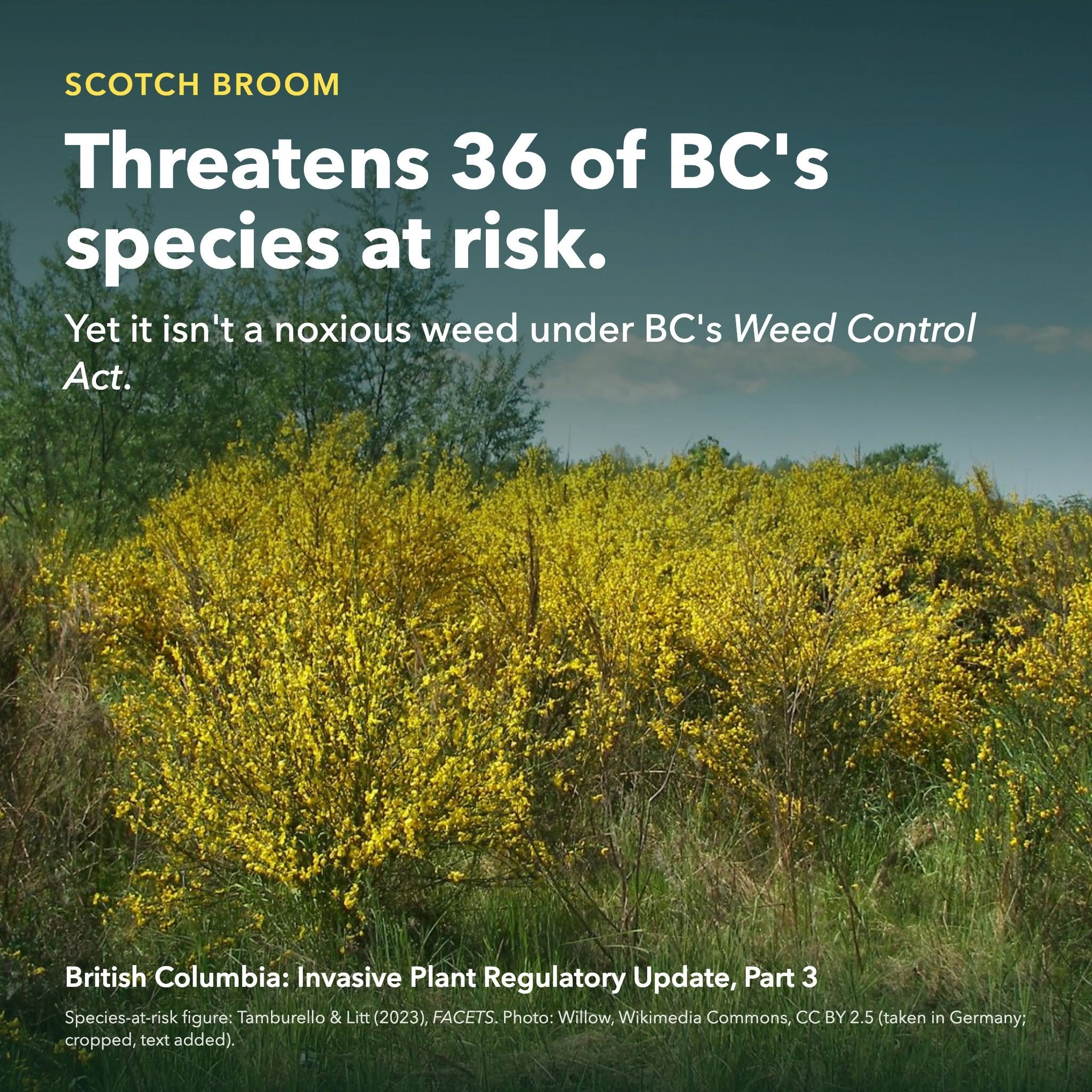
Take Scotch broom as an example. According to a 2023 study in FACETS, Scotch broom threatens 36 of BC’s species at risk, more than any other invasive plant. Broom is regulated under the Forest and Range Practices Act, which requires forest and range operators to take measures to prevent its introduction or spread where they work. It is also on the provincial schedule that lets municipalities act. But the one law that applies to every landowner, and to the Province itself, leaves it out.
In 2022, the volunteer BroomBusters Invasive Plant Society asked the Province to list broom as a noxious weed. It also asked local governments to pass bylaws to prevent its spread. The Municipality of North Cowichan considered supporting a provincial listing, then backed away. It cited limited funding and staff. As one councillor put it, if the municipality couldn’t adopt that goal for itself, it shouldn’t ask the Province to require it.
This isn’t only a BC story, and it isn’t new. BC’s 1911 Act named oxeye daisy and burdock as noxious weeds across the province; today each is listed only in some regional districts. Earlier in this series, I described how Manitoba dropped purple loosestrife from its noxious weed rules in 2017, after it had become widespread, and how Alberta removed creeping bellflower in 2026. It happens federally too. When the Canadian Food Inspection Agency revised the Weed Seeds Order in 2016, it moved species like leafy spurge out of its prohibited class as they had become too widely distributed to qualify.
But controlling established populations and preventing further spread are different objectives. A plant can be too widespread for eradication to be realistic and still warrant restrictions on its sale and intentional spread.
Montana offers one alternative. Its Priority 3 “regulated plants,” including Russian olive and parrot feather, are not classified as noxious weeds, so their designation does not impose the same mandatory control obligation on landowners. However, they may not be intentionally spread or sold.
Closer to home, Squamish, Whistler and Lillooet have chosen to ban the sale of broom and English ivy, making it clear to the public and to the industry that these are plants that can harm the environment.
BC needs a law that can stop the sale and spread of a plant without first deciding who must pay to dig it up. Better still, the federal government needs legislation that does this across the country.
A LAW THAT’S HARD TO READ
I find BC laws and lists confusing, and I am not alone. The confusion starts with the noxious weed list itself. Alongside 39 provincial weeds, the Weed Control Regulation lists 27 “regional weeds,” each noxious only in named regional districts. Wild chervil, sold in garden centres as ‘Ravenswing’, is noxious only in the Fraser Valley Regional District. Eleven of the 27, mostly farm weeds, apply only in the Peace River district, and none applies in Metro Vancouver or on Vancouver Island. Regional district boundaries are administrative, not ecological, and a plant bought in one district can easily be planted in another. The list also still uses outdated scientific names, such as Kochia scoparia and Lychnis alba.
BC’s Spheres of Concurrent Jurisdiction regulation, which lists the invasive plants municipalities may choose to regulate, copies the same regional table. So it allows municipalities to regulate some invasive species, like kochia, only in a single region (Peace River). The municipal framework is difficult to interpret and uneven in its application. Its lists are also outdated and inconsistent: the province-wide list names giant knotweed twice, gives most plants by common name only (“baby’s breath,” for instance, can mean more than one species), and leaves out ten of the Province’s own noxious weeds.
The regulations leave uncertainty about whether municipalities can prohibit plant sales, what constitutes a “wild flower,” which provincial weed lists they may use, and when to seek minister approval. The framework also leaves gaps: Vancouver, regional districts and Gulf Islands local trust committees lack the same invasive-species powers available to other municipalities. These ambiguities complicate action by local governments, retailers and gardeners alike.
EVERYONE AGREES, WHO WILL ACT?
Since 2008, BC local governments have asked the Province at least six times, through the Union of BC Municipalities (UBCM), to stop the sale of invasive plants.
he Province’s initial replies had a familiar ring. They pointed to existing mechanisms for educating landowners and gardeners, and to how partnerships with the horticulture industry and voluntary programs can be effective. In 2008, the Province noted that existing laws let local governments require control of certain noxious weeds, but that the only power to prohibit a sale, of “wildflowers,” was “weakly defined.”
In 2023, the Province’s responses fully acknowledged the problem: “High-risk invasive plant species and their pathways of introduction and spread are not adequately controlled and there are limited provisions to stop the retail sale, trade, barter, gifting or movement of regulated species.” Its Inter-Ministry Invasive Species Working Group had found the Weed Control Act “antiquated and not feasible to update,” and recommended exploring a new, comprehensive act instead.
The Province called closing pathways such as sale “a cost-effective and critical approach to reduce risk and future impacts.” The same reply warned that “creating new legislation is a large undertaking,” and promised “improved policy solutions” in the interim. Three years later, BC has no new act.
While they wait, some municipalities have taken legislative action. Elsewhere, communities are left to lean into their shovels voluntarily, or to live with a growing problem.
TOO MANY LISTS
Invasive plant lists abound in BC: three legal lists, the Province’s priority list, about a dozen regional lists and a growing number of municipal ones. What’s missing isn’t a list. It’s a better link between the science-based lists and the law.
The Province already has a good place to start. Its Inter-Ministry Invasive Species Working Group ranks species using “a science-based risk assessment process” in its Provincial Priority Invasive Species list, last updated in April 2026. The Province’s own website says that “preventing the initial introduction, establishment and spread of invasive plants is the single most effective method of invasive plant control,” and that “‘shelf ready’ risk assessments are a key part of prevention.”
So use them. Plants on the priority list that are sold in the horticultural trade should be phased out, and the list should be written into law as a living document updated as new evidence emerges. Better still, a national bank of shared, “shelf-ready assessments” would spare each province from repeating the work.
REGIONAL RISK AND A FUTURE SALES LIST
Opponents of province-wide and country-wide rules often argue that invasive plant risk is regional. A plant that is a problem on the coast may be harmless in the Interior, so why ban it everywhere? BC’s regional weed list, described above, says where control is required, not what may be sold. Regional differences are real, and regional invasive species organizations rightly set different priorities in response to risk assessments.
However, the horticultural trade already filters plants according to what gardeners can grow locally. Nurseries carry plants suited to their markets and regional growing conditions. Long-term studies of nursery catalogues in Britain and New Zealand found that ornamental plants sold more widely and more cheaply were more likely to escape and establish in the wild (Dehnen-Schmutz et al., 2007; Dawes et al., 2026).
Risk-assessment science has advanced considerably. Many plants known to invade multiple geographic regions and habitats have been assessed and ranked, including high-risk species such as tree-of-heaven. In 2021, CFIA’s own web page told Canadians, “Do not plant tree-of-heaven,” and noted that “intentional planting has been the most significant factor” in its spread to new regions. But it was only advice. The tree remained legal to import and sell, and CFIA left it to the provinces to act. Of the provinces I’ve reviewed, only Ontario has; BC has not.
Tree-of-heaven is unlikely to survive in Ontario’s far north, yet Ontario’s ban on its sale, effective January 1, 2024, under the Invasive Species Act, 2015, applies province-wide. A province-wide rule is simpler than a patchwork of regional restrictions. Sales restrictions matter where a plant can survive, which is also where it is sold. The European Union takes the same approach: since 2019, tree-of-heaven has been banned from sale throughout the EU, including its boreal north. Regional differences in risk deserve consideration, but they should guide how restrictions are applied, not create gaps that allow high-risk plants to keep moving through the horticultural trade.
MOVING FORWARD
BC already has the science, the lists and willing partners. What it lacks is a legal framework that connects them:
- A legally binding provincial list of plants that may not be sold, based on risk, with regional tiers where the science supports them. (Labelling laws may be useful for lower-risk or habitat-limited plants.)
- Sale kept separate from control. A plant can be too widespread to require control everywhere and still be too risky to sell or share.
- Clear local authority: add “sale” to the municipal power, bring the provincial schedule into line with the noxious weed list, and give Vancouver and regional districts the same tools.
- A shared record of risk assessments, so that a plant’s absence from a list means something: assessed and found low risk, or never assessed. (Such lists must be revisited over time if new evidence arises.)
- A legal floor under the voluntary programs. Grow Me Instead, PlantWise and the Recognized Retailer program are already helping retailers phase out invasive plants. A consistent list would give responsible retailers the level playing field the nursery association has asked for.
The Province has already said much of this itself. Its own working group found the Weed Control Act “not feasible to update” and recommended exploring a new, comprehensive act as “the best approach.” The next step is to write it.
FEDERAL ROLE
Just as BC municipalities have called for better provincial action, the provinces and territories need to call upon the federal government to do its part. The federal government serves the common good by managing issues of national and international concern. Under the Kunming-Montreal Global Biodiversity Framework, Canada has committed to cutting the rate at which invasive species are introduced and become established by at least 50 per cent by 2030. With horticulture the main pathway for invasive plants, that target can’t be met one town at a time.
In 2011, the Canadian Food Inspection Agency’s Canadian Invasive Plant Frameworkdivided the work. The federal government took responsibility for invasive plants “not yet in Canada or present but not widely distributed, and being under official control.” Plants already established in Canada, including those sold in garden centres, fell to provincial, territorial and municipal governments. The result has been duplicated effort and wide disparities across the country.
Labelling would help too, and it is best done nationally, since plants are shipped across provincial lines. An English ivy sold as a houseplant, for example, could carry a label saying not to plant it outdoors or dump it. New York State has required such labels since 2015: businesses selling regulated invasive plants must label them “Invasive Species – Harmful to the Environment.”
Who owns the problem? In the end, all of us do. But only governments can write the rules that stop it at the point of sale. Next, I turn to the territories.
SOURCES
LEGISLATION
European Union. (2019). Commission Implementing Regulation (EU) 2019/1262, amending Implementing Regulation (EU) 2016/1141 to update the list of invasive alien species of Union concern. https://eur-lex.europa.eu/eli/reg_impl/2019/1262/oj/eng
Ontario. (2023). O. Reg. 380/23, amending O. Reg. 354/16 (General) under the Invasive Species Act, 2015 (tree-of-heaven added; in force January 1, 2024). https://www.ontario.ca/laws/regulation/r23380
British Columbia. (2003). Community Charter, SBC 2003, c. 26, ss. 8–9 and Schedule (definitions). https://www.bclaws.gov.bc.ca/civix/document/id/complete/statreg/03026_00
British Columbia. (2004). Spheres of Concurrent Jurisdiction – Environment and Wildlife Regulation, B.C. Reg. 144/2004, s. 2. https://www.bclaws.gov.bc.ca/civix/document/id/complete/statreg/144_2004
British Columbia. (1953). Vancouver Charter, SBC 1953, c. 55. https://www.bclaws.gov.bc.ca/…/complete/statreg/vanch_00
British Columbia. (1996). Weed Control Act, RSBC 1996, c. 487, ss. 1–2. https://www.bclaws.gov.bc.ca/civix/document/id/complete/statreg/96487_01
British Columbia. (1985). Weed Control Regulation, B.C. Reg. 66/85, Schedule A. https://www.bclaws.gov.bc.ca/…/complete/statreg/10_66_85
British Columbia. (1911). An Act for the Eradication of and to prevent the Spreading of Noxious Weeds (Noxious Weeds Act), S.B.C. 1911, c. 60, s. 2. BC Laws historical statutes. https://www.bclaws.gov.bc.ca/…/id/hstats/hstats/902350616
Canada. (2016). Weed Seeds Order, 2016, SOR/2016-93, with Regulatory Impact Analysis Statement. Canada Gazette, Part II, 150(10). https://gazette.gc.ca/…/2016…/html/sor-dors93-eng.html
GOVERNMENT AND ORGANIZATION PUBLICATIONS
Canadian Food Inspection Agency. (2009, October 23). Weed Seeds Order review: Proposal for change, section 6.0 [archived]. https://inspection.canada.ca/…/1382373…/1382373924402…
BC Inter-Ministry Invasive Species Working Group. (2026, April). Provincial priority invasive species. https://www2.gov.bc.ca/…/provincial_priority_is_list.pdf
Government of British Columbia. (2026, June 2). Priority invasive species. https://www2.gov.bc.ca/…/invasive-species/priority-species
Canadian Food Inspection Agency. (2021, February 12). Tree-of-heaven – Ailanthus altissima (Mill.) Swingle [Web page, archived September 1, 2022]. https://web.archive.org/web/20220901022756/https://inspection.canada.ca/plant-health/invasive-species/invasive-plants/invasive-plants/tree-of-heaven/eng/1612898593817/1612898594354
Convention on Biological Diversity. (2022). Kunming-Montreal Global Biodiversity Framework, Target 6. https://www.cbd.int/gbf/targets/6
New York State Department of Environmental Conservation. (n.d.). Invasive species regulations (6 NYCRR Part 575). https://dec.ny.gov/…/resources-regulations/regulations
Canadian Food Inspection Agency (Lindgren, C., & Gauthier, M.). (2011). Canadian Invasive Plant Framework: A collaborative approach to addressing invasive plants in Canada. Not available online; discussed in Canadian Coalition for Invasive Plant Regulation (2024), below.
Canadian Coalition for Invasive Plant Regulation. (2024). Reducing the sales of invasive plants. https://ccipr.ca/…/CCIPR-Reducing-Sales-of-Invasive…
British Columbia Ministry of Municipal Affairs and Housing. (2017, October). A guide to local government actions requiring approval by the Province. https://www2.gov.bc.ca/…/guide_to_local_government…
Montana Department of Agriculture. (2019). Montana noxious weed list(effective June 21, 2019). https://agr.mt.gov/…/2019-Montana-Noxious-Weed-List.pdf
Union of BC Municipalities. (2008). Sale of invasive plant seeds[Resolution B71, Cariboo RD, with provincial response]. https://www.ubcm.ca/…/resolut…/sale-invasive-plant-seeds
Union of BC Municipalities. (2011). Regulation of sale of plants seeds[Resolution B44, Cariboo RD, with provincial response]. https://www.ubcm.ca/…/reso…/regulation-sale-plants-seeds
Union of BC Municipalities. (2017). Ban on the sale of invasive species[Resolution B28, Squamish-Lillooet RD, with provincial response]. https://www.ubcm.ca/…/resolut…/ban-sale-invasive-species
Union of BC Municipalities. (2020). Invasive Species Act [Resolution NR57, Burns Lake, with provincial response]. https://www.ubcm.ca/…/resolutions…/invasive-species-act
Union of BC Municipalities. (2023). Invasive species amendment to the Weed Control Act [Resolution EB34, Okanagan-Similkameen RD, with provincial response]. https://www.ubcm.ca/…/invasive-species-amendment-weed…
Union of BC Municipalities. (2023). Ban on the sale of invasive plant species [Resolution EB35, West Vancouver, with provincial response]. https://www.ubcm.ca/…/ban-sale-invasive-plant-species
RESEARCH AND COMMENTARY
Peter A. Allard School of Law, University of British Columbia. (2023). Scotch broom sweeps through BC: Limited options for BC individuals to enforce invasive plant control [Blog]. https://allard.ubc.ca/…/scotch-broom-sweeps-through-bc…
Tamburello, N., & Litt, M. A. (2023). Multiple impacts of invasive species on species at risk: A case study in British Columbia, Canada. FACETS, 8, 1–13. https://doi.org/10.1139/facets-2022-0234
Dawes, T. N., Bufford, J. L., & Hulme, P. E. (2026). A century of ornamental plant trade reveals consistently lower prices for naturalised species. Journal of Applied Ecology, 63(1), e70255. https://doi.org/10.1111/1365-2664.70255
Dehnen-Schmutz, K., Touza, J., Perrings, C., & Williamson, M. (2007). A century of the ornamental plant trade and its impact on invasion success. Diversity and Distributions, 13(5), 527–534. https://doi.org/10.1111/j.1472-4642.2007.00359.x
Pergl, J. (2018). EU non-native organism risk assessment scheme: Ailanthus altissima (final version, approved by the EU IAS Scientific Forum, March 2018).