Originally published on the CCIPR Facebook group October 26, 2026
I smiled at a comment on my Alberta and Saskatchewan overview: “TL;DR.”
For a Facebook post, I know these are long. I share them as references for those who, like me, want to better understand how we are collectively responding to the invasive species crisis, how we choose to regulate invasive plants, and how we might do better. But I’ve taken the comment to heart, so I’ll begin with a short summary before the fuller BC story below. – Cathy Kavassalis
SUMMARY
- British Columbia has three laws with lists of weeds or invasive plants. The main one, the Weed Control Act, requires control once weeds are growing. None of the three prohibits the sale of invasive plants.
- Each law has its own list, and the lists don’t match. One is partly regional; another sets out which plants municipalities may choose to regulate; the third applies only to forest and range operations.
- The Province’s own science-based priority list names high-risk plants that no BC law covers.
- About a dozen regional invasive species organizations keep their own priority lists, most with no legal standing.
- Six municipalities have banned, or are moving to ban, the sale of some invasive plants, using different bylaws and different lists. Neighbouring communities can have very different rules.
- The nursery industry finds the many different lists confusing; its association has called for more consistent, robust lists.
A note on how I prepared this series: I used Claude, an AI assistant, to help analyze and compare the laws, lists and strategy documents, and to check my writing against the original sources. Any errors are mine, and I always welcome corrections.
With that, let me begin.
ABOUT THIS SERIES
BC is Canada’s most biologically diverse province, with climates ranging from coastal rainforest to dry interior grassland and northern boreal forest. All are threatened by invasive plants.
Like its landscapes, the BC regulatory system is complex, spread across several laws, ministries and levels of government. On top of this sits a layer of regional invasive species programs, each with its own priority list.
I have divided this update into three parts:
- Part 1 (this post) gives an overview of the provincial laws and how they compare with the Province’s own science.
- Part 2 looks at the municipalities that have begun banning invasive plant sales on their own.
- Part 3 steps back for some analysis: why reform has stalled, why “it’s only a problem in one region” doesn’t work for plants in the horticultural trade, and what BC’s experience means for invasive plant regulation across Canada.
A LONG HISTORY OF WEED LAW
Like other provinces, BC regulated weeds from early on. Its first thistle law, the Thistle Prevention Act of 1877, came six years after BC joined Confederation and didn’t apply on the Mainland north and east of the Cascades. A noxious weeds law followed in 1888. In 1911, a single Noxious Weeds Act replaced both and applied to the whole province (S.B.C. 1911, c. 60).
The 1911 Act named its weeds right in the statute, just as Alberta’s 1907 Act and Saskatchewan’s 1909 Act did: “perennial thistles, oxeye daisies, wild oats, rag-weed, charlock, sorrel, burdock, wild mustard, tumbling mustard, shepherd’s purse, or stink-weed.” Owners had to cut them down or face a fine of five to twenty-five dollars.
Two features of that 115-year-old law stand out today.
First, it bound the Crown. Noxious weeds on unoccupied Crown land were to be destroyed by the Government Agent, at the Province’s expense. That detail matters: once a weed becomes widespread, the cost of control can become a significant public burden.
Second, it went after the pathway as well as the plant. Anyone who imported and sold grain, grass, clover or other seed containing noxious weed seed faced a fine of twenty to one hundred dollars. That was up to four times the penalty for failing to control the weeds themselves. In 1911, legislators understood that it is cheaper to stop weeds at the point of sale than to pull them from every field.
BC still regulates contaminated grain screenings and topsoil. However, more than a century later, it does not regulate the sale of invasive plants themselves.
So how does BC regulate invasive plants? BC has not one legal list of invasive plants but three, under three different laws. Alongside them sits a growing stack of advisory lists that have no legal force on their own, including:
- the Province’s own science-based priority list
- the Invasive Species Council of BC’s Grow Me Instead list
- the lists of about a dozen regional invasive species organizations, from Vancouver Island to the Northwest, most with their own priority list (such as the Invasive Species Council of Metro Vancouver’s – ISCMV’s)
Various combinations of lists are now being used by municipalities in their legislation, as we will see in Part 2.
THREE LAWS, THREE LISTS
1. The Weed Control Act: noxious weeds
BC’s Weed Control Act (RSBC 1996, c. 487) is short and to the point: “an occupier must control noxious weeds growing or located on land and premises.” A noxious weed is simply a weed designated by regulation, along with its seeds. As in Alberta and Saskatchewan, the Act itself sets no criteria for what should be designated.
The Weed Control Regulation (B.C. Reg. 66/85) designates 39 noxious weeds throughout the province and 27 more in specific regional districts. This list was last updated in 2011.
Provincial noxious weeds familiar to gardeners include:
- flowering rush (Butomus umbellatus)
- garlic mustard (Alliaria petiolata)
- giant hogweed (Heracleum mantegazzianum)
- giant mannagrass (Glyceria maxima)
- knotweeds: Bohemian, giant and Japanese (listed under the older genus Fallopia, now Reynoutria), and Himalayan (listed as Polygonum polystachyum, now Persicaria wallichii)
- purple loosestrife (Lythrum salicaria)
- European common reed (Phragmites australis subsp. australis)
- yellow flag iris (Iris pseudacorus)
- yellow toadflax (Linaria vulgaris, listed as “common toadflax”)
The regional list is where things get interesting, and confusing. Wild chervil (Anthriscus sylvestris), sold in garden centres as the cultivar ‘Ravenswing’, is a noxious weed only in the Fraser Valley Regional District. Oxeye daisy (Leucanthemum vulgare, listed as Chrysanthemum leucanthemum) is noxious in only four regional districts. Common tansy (Tanacetum vulgare) is noxious in five districts, and field scabious (Knautia arvensis) in three. Cross a regional district boundary and a plant’s legal status can change.
What the Act does not do is address the sale of plants. The regulation does prohibit selling grain screenings containing noxious weed seed. It also prohibits selling fertilizer, lime or topsoil containing a noxious weed or its seed for delivery into an area where that weed isn’t established. That’s a sensible pathway rule. But nursery stock and seed packets aren’t mentioned.
2. The Forest and Range Practices Act: invasive plants on Crown land
BC’s second list comes from forestry. Under section 47 of the Forest and Range Practices Act (SBC 2002, c. 69), anyone carrying out a forest or range practice must carry out measures “to prevent the introduction or spread of prescribed species of invasive plants.”
This is the only BC law I found that frames the obligation as preventing introduction. But it applies only to forest and range operations, largely on Crown land.
The Invasive Plants Regulation (B.C. Reg. 18/2004) prescribes 42 species. Some are not on the provincial noxious weed list, including:
- baby’s breath (Gypsophila paniculata)
- Scotch broom (Cytisus scoparius)
- St. John’s wort (Hypericum perforatum)
- teasel (Dipsacus fullonum)
The list hasn’t been amended since it was made in January 2004.
3. The Community Charter: what municipalities may regulate
The third list belongs to municipalities. The Community Charter is the BC law that sets out what most municipalities can do. Vancouver has its own charter, rural areas are run by regional districts under a different law, and First Nations reserve and treaty lands fall outside it altogether. It’s complicated! The Charter permits councils to pass bylaws to protect the natural environment. The invasive species that municipalities may regulate without provincial approval are listed in a regulation called the Spheres of Concurrent Jurisdiction – Environment and Wildlife Regulation (B.C. Reg. 144/2004).
The regulation’s schedule of “alien invasive species” goes beyond the Weed Control Act‘s noxious weed list. It includes many invasive garden plants that dominate BC’s urban natural areas:
- English ivy (Hedera helix)
- Himalayan blackberry (Rubus armeniacus)
- spurge laurel (Daphne laureola)
- Himalayan balsam (Impatiens glandulifera)
- Scotch broom (Cytisus scoparius)
- reed canary grass (Phalaris arundinacea)
(The schedule itself is oddly put together. A first group of “Plants” gives common and scientific names. Two more groups, “Terrestrial Vascular Plants” and “Fresh Water/Riparian Vascular Plants,” give common names only. Some plants appear twice: common toadflax (Linaria vulgaris) in the first group shows up again as “yellow toadflax” in the second, and giant knotweed is listed twice in the same group. In my humble opinion, it’s a poorly written schedule.)
The regulation speaks of the “control and eradication” of these species and doesn’t mention sale. But several BC municipalities, and Surrey’s lawyers, read “control” broadly: stopping sales is one way to stop the spread. That is the story of Part 2.
Nearly twenty years, little change
In 2007, the Invasive Plant Council of BC (now the Invasive Species Council of BC) published A Legislative Guidebook to Invasive Plant Management in BC. It described a framework so fragmented that land managers struggled to know which law applied. Since then, of BC’s three legal plant lists, only the noxious weed list has been updated. In 2011, 18 species were added to the provincial list. These included the knotweeds, garlic mustard, giant hogweed, purple loosestrife and yellow flag iris. Notably absent, then and now: Scotch broom, English ivy, Himalayan blackberry and spurge laurel, some of the most visible invaders in southwest BC.
The 2007 guidebook, written for land managers, was entirely about control. Sale was not mentioned. That hasn’t changed either.
It isn’t for lack of asking, or of plans. A 2012 provincial review proposed bringing the sale of noxious species into the regulation, and local governments have asked the Province to stop invasive plant sales at least five times since 2008. I look at that history, and why it has stalled, in Part 3.
AQUATIC INVASIVE PLANTS: A NOTABLE GAP
In Alberta and Manitoba, aquatic invasive plants are regulated under fisheries or water legislation that prohibits possessing, importing or releasing them, which in effect bans their sale. Ontario’s Invasive Species Act and Québec’s new regulation also prohibit the sale of many aquatic plants.
BC’s equivalent tool is the Controlled Alien Species Regulation (B.C. Reg. 94/2009) under the Wildlife Act. It was amended as recently as April 2026, but it contains no plants. Its list of aquatic invasive species consists only of mussel species.
Some aquatic and wetland plants do appear on BC’s other lists: flowering rush, yellow flag iris, purple loosestrife and common reed are provincial noxious weeds, and the municipal schedule adds Eurasian watermilfoil and hydrilla. But like the land plants, they come with a duty to control, not a ban on sale.
So no provincial law in BC prohibits the possession, sale or release of any aquatic invasive plant.
THE SCIENCE IS AHEAD OF THE LAW
BC has a Provincial Priority Invasive Species list, prepared by the BC Inter-Ministry Invasive Species Working Group and most recently updated in April 2026. The government describes it as built on “a science-based risk assessment process.” It sorts species into five categories, from Prevent (high risk, not yet established) through to Management (widespread but may be of concern).
It is an impressive piece of work. But it is a policy document, not a regulation.
Consider some of the high-risk ornamental plants on the list, such as tree of heaven, princess tree and English holly, or aquatic plants associated with the aquarium and water-garden trades, including water hyacinth, water lettuce and yellow floating heart. None of these is designated under any BC law, let alone banned from sale.
ENFORCEMENT
Under the Weed Control Act, the minister appoints inspectors, and municipal councils “may” appoint their own inspectors and weed control officers (s. 10). As in Saskatchewan, local enforcement is discretionary; in Alberta it is mandatory.
Councils may also set up weed control committees (s. 9). I was pleased to see that these must include a member of a society whose primary purpose is environmental protection. Committees can compile a local list of weeds they consider noxious and submit it to the minister.
An inspector can serve notice requiring an occupier to control noxious weeds. If the weeds aren’t controlled, the inspector can do the work and add the cost to the property taxes.
EDUCATION AND OUTREACH
Now for the good news. BC’s outreach on horticultural invasives is among the strongest in the country.
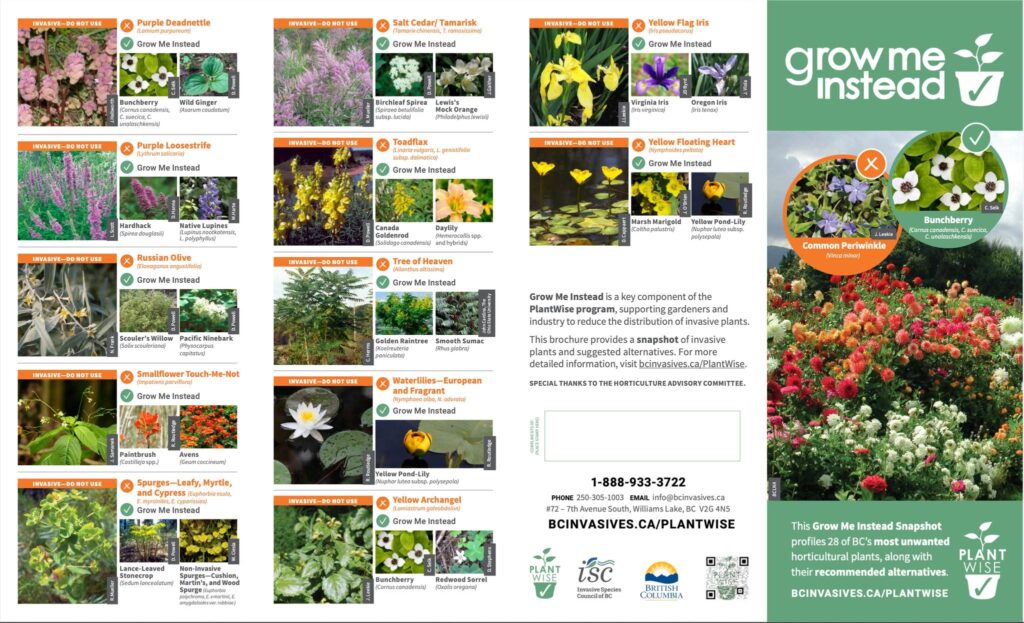
The Invasive Species Council of BC (ISCBC) runs PlantWise, a program that helps the horticulture industry phase out invasive plants. It includes free training and a Recognized Retailer pilot for garden centres, much like New Brunswick’s PlantWise Partner Program. The BC Landscape & Nursery Association supports this educational approach directed at retailers. I was heartened to hear its Executive Director on CBC Radio in August, asking for the Grow Me Instead resources to be updated. She also noted that the many lists, built with different criteria and expertise, vary from one municipality to the next, and that the industry wants and needs more consistency.
ISCBC’s Grow Me Instead list names 33 of horticulture’s most “unwanted” invasive plants and suggests alternatives for each. First produced in 2008, it was last revised in 2021, with industry experts, to focus on invasive plants still sold in the trade.
But compare those 33 plants with the law:
- 12 of the 33 plants are provincial noxious weeds or prescribed under the forestry regulation.
- 4 appear only on the list of plants municipalities can regulate if they choose.
- 17 have no legal designation anywhere in BC law.
- 0 are prohibited from sale by provincial law.
The 17 with no legal status include butterfly bush, common periwinkle, cypress spurge, English holly, foxglove, Russian olive, tree of heaven, yellow archangel and yellow floating heart.
ISCBC is asking gardeners and retailers not to buy or sell these 33 plants. Provincial law doesn’t back them up on a single one. Only the handful of municipalities with sales bylaws back up some of them, and only within their own boundaries.
REPORTING
British Columbians can report invasive plants using the Report Invasives mobile app (Android and iOS), the online reporting form, or by emailing invasive.plants@gov.bc.ca with a photo. (The older Report-a-Weed app has been retired.) Reports are reviewed by provincial invasive species specialists.
FINAL THOUGHT
BC has many of the pieces in place:
- a science-based provincial priority list, updated this year
- an early detection and rapid response program
- the Invasive Species Council of BC’s PlantWise and Grow Me Instead programs, and about a dozen regional organizations working on the ground
- municipalities willing to act on their own
What it lacks is a legally binding, science-based provincial list of plants that may not be sold, flexible enough to reflect regional differences in risk. Today, the plants BC’s own specialists rank as high risk are not the plants its laws cover, and those laws only require control once a plant is growing. None of them asks whether a plant should be sold in the first place.
In Part 2, I look at the BC municipalities that have decided not to wait. In Part 3, I step back to ask why reform has stalled for so long, and what that means for invasive plant regulation across Canada.
SOURCES
LEGISLATION
British Columbia. (1877). An Act to prevent the spread of Thistles (Thistle Prevention Act, 1877), No. 12 [Assented to 18th April, 1877]. BC Laws historical statutes. https://www.bclaws.gov.bc.ca/…/id/hstats/hstats/2011105260
British Columbia. (1911). An Act for the Eradication of and to prevent the Spreading of Noxious Weeds (Noxious Weeds Act), S.B.C. 1911, c. 60 [1st March, 1911]. BC Laws historical statutes. https://www.bclaws.gov.bc.ca/…/id/hstats/hstats/902350616
British Columbia. (1996). Weed Control Act, RSBC 1996, c. 487. https://www.bclaws.gov.bc.ca/…/complete/statreg/96487_01
British Columbia. (1985). Weed Control Regulation, B.C. Reg. 66/85 (Schedule A last amended B.C. Reg. 143/2011). https://www.bclaws.gov.bc.ca/…/complete/statreg/10_66_85
British Columbia. (2002). Forest and Range Practices Act, SBC 2002, c. 69, s. 47. https://www.bclaws.gov.bc.ca/…/complete/statreg/02069_01
British Columbia. (2004). Invasive Plants Regulation, B.C. Reg. 18/2004. https://www.bclaws.gov.bc.ca/…/id/complete/statreg/18_2004
British Columbia. (2003). Community Charter, SBC 2003, c. 26, ss. 8–9. https://www.bclaws.gov.bc.ca/civix/document/id/complete/statreg/03026_00
British Columbia. (2004). Spheres of Concurrent Jurisdiction – Environment and Wildlife Regulation, B.C. Reg. 144/2004 (as amended to B.C. Reg. 155/2024). https://www.bclaws.gov.bc.ca/civix/document/id/complete/statreg/144_2004
British Columbia. (2009). Controlled Alien Species Regulation, B.C. Reg. 94/2009 (as amended to B.C. Reg. 71/2026). https://www.bclaws.gov.bc.ca/…/id/complete/statreg/94_2009
GOVERNMENT AND ORGANIZATION PUBLICATIONS
Ralph, D. (2012, March 28). Weed Control Act and Regulation: Regulatory change and moving forward [Presentation]. PRRD/NEIPC Agriculture Weed Day, Dawson Creek. BC Ministry of Forests, Lands and Natural Resource Operations. https://www.slideserve.com/…/prrd-neipc-agriculture…
Union of BC Municipalities. Resolutions database and provincial responses: B71 (2008), B44 (2011), B28 (2017), NR57 (2020), EB34 (2023). https://www.ubcm.ca/conv…/resolutions/resolutions-database
Invasive Plant Council of British Columbia. (2007, December). A legislative guidebook to invasive plant management in BC (Report #3). https://rec.rdos.bc.ca/…/A-Legislative-Guidebook-to…
BC Inter-Ministry Invasive Species Working Group. (2026, April). Provincial priority invasive species. https://www2.gov.bc.ca/…/provincial_priority_is_list.pdf
Government of British Columbia. (2026, June 2). Priority invasive species. https://www2.gov.bc.ca/…/invasive-species/priority-species
Government of British Columbia. (2024, December 2). Reporting invasive species. https://www2.gov.bc.ca/…/inv…/reporting-invasive-species
Invasive Species Council of British Columbia. (n.d.). PlantWise.https://bcinvasives.ca/play-your-part/plantwise/
Invasive Species Council of British Columbia. (n.d.). Grow Me Instead. https://bcinvasives.ca/play…/plantwise/grow-me-instead/
Invasive Species Council of British Columbia. (2021). Grow Me Instead: A snapshot of 28 of BC’s most ‘unwanted’ horticulture plants along with recommended alternatives. https://bcinvasives.ca/…/PlantWise-GMI-Brochure-2021…
Invasive Species Council of British Columbia. (2013). Grow Me Instead: A guide for British Columbia. Copy hosted by the Regional District of Nanaimo: https://www.rdn.bc.ca/cms/wpattachments/wpID878atID6972.pdf
CBC Radio, The Early Edition with Stephen Quinn. (2026, August 6). Surrey proposes ban on sale of invasive plants [Interview with Coreen Rodger Berrisford, BC Landscape & Nursery Association].(link can’t be shared via FB)
Sea to Sky Invasive Species Council. (2026, June 12). SSISC invasive plants list. https://ssisc.ca/…/SSISC-Invasive-Plants-List-EXTERNAL…
Northwest Invasive Plant Council. (2026). NWIPC priority plant list 2026. https://www.nwipc.org/…/NWIPC-Priority-Plant-List-2026.pdf
Okanagan and Similkameen Invasive Species Society. (2026, April). OASISS prioritized invasive plant species. https://99d08738-446d-4774-8b44-d628a91f18ab.filesusr.com…
Columbia Shuswap Invasive Species Society. (2026). Invasive plant priority ranking list 2026. https://columbiashuswapinvasives.org/…/CSISS-Invasive…
Boundary Invasive Species Society. (2025, May). Operational plan for invasive species management in the Boundary 2021 to 2026. https://www.boundaryinvasives.com/…/34e3ff…
Invasive Species Council of British Columbia. (2023). PlantWise Recognized Retailer pilot program: Implementation guide for retail partners. https://bcinvasives.ca/…/MB-Edits-Final_ISCBC-2023…