Originally published September 23, 2026 on the CCIPR Facebook group
As we continue this series of updates on regulatory progress across Canada, we visit Manitoba, home to the prairie crocus to the south and polar bears to the north.
Manitoba has a long history of regulating plants considered injurious to agriculture. In the first session of the first legislature of Manitoba, members passed Bill 52, An Act for the better protection of Agriculture by the destruction of Canada Thistles, on May 3, 1871.
Over time, Manitoba has moved from targeting a single agricultural threat to a tiered system for noxious weed management that recognizes that some plants can harm more than agricultural production. The system provides for management enforced through municipal inspectors and weed control districts.
The regulation does not prevent sales of potentially invasive plants, but by designating plants as noxious weeds, it does provide a clear signal that these plants should not be planted or allowed to spread.
A second regulatory system was introduced in 2015. This system specifically addresses aquatic invasive species. Under The Water Protection Act (C.C.S.M. c. W65), it is prohibited to possess and transport designated invasive aquatic plants. This possession ban is one of the more comprehensive prohibitions of aquatic invasive plants in Canada.
WHAT’S REGULATED
Noxious weeds
The Noxious Weeds Regulation currently designates around 90 plants in three tiers. Tier 1 has 21 entries and requires destruction. Tier 2 has 19 entries, with destruction required where the colonized area is less than 20 acres and control required at 20 acres or more. Tier 3 has 50 entries and requires control where uncontrolled growth or spread is likely to negatively affect Manitoba’s economy or environment or the well-being of nearby residents.
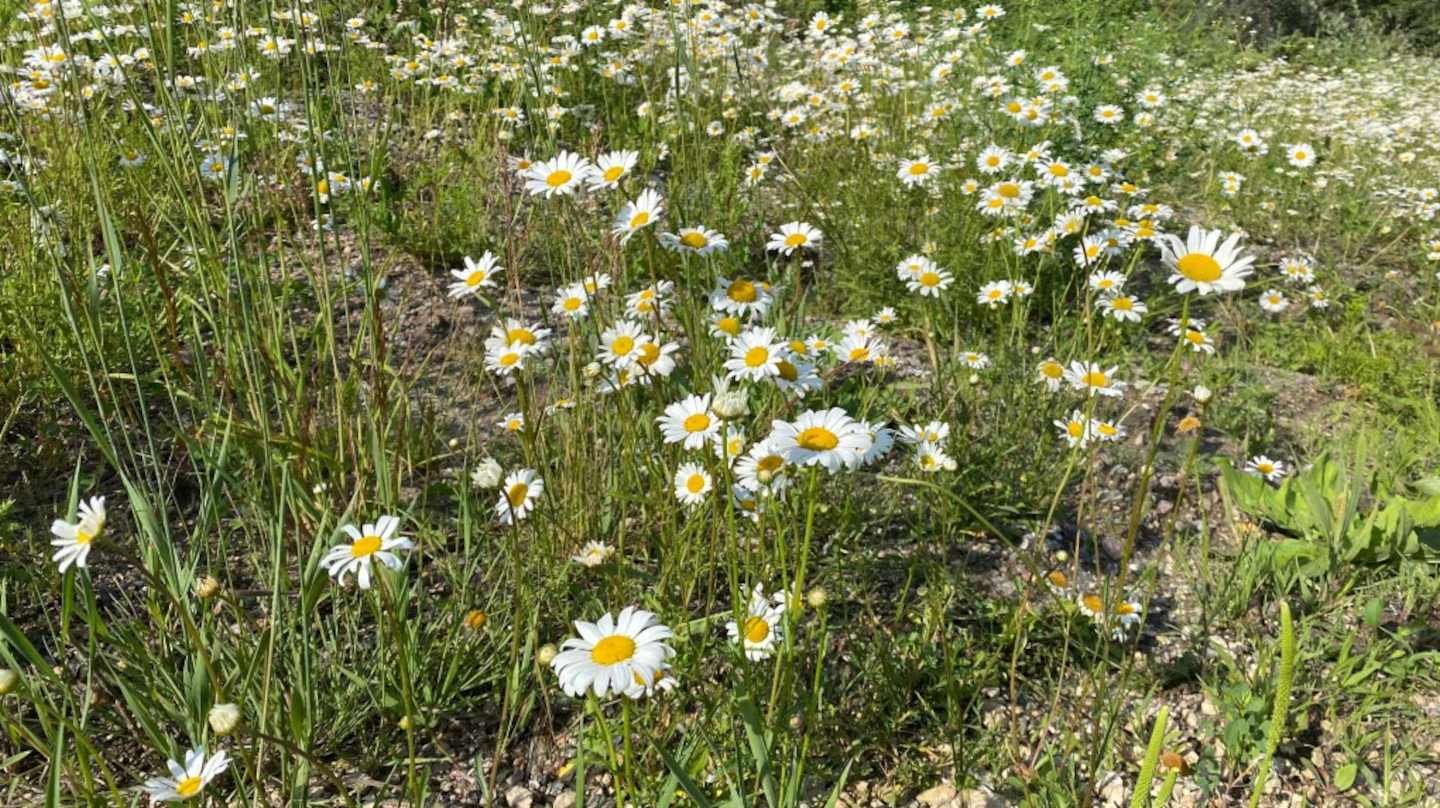
The lists include plants familiar to gardeners. Tier 1 includes Japanese knotweed (Reynoutria japonica), giant hogweed (Heracleum mantegazzianum) and garlic mustard (Alliaria petiolata). Tier 2 includes baby’s-breath (Gypsophila paniculata), bouncing bet (Saponaria officinalis), ox-eye daisy (Leucanthemum vulgare), common tansy (Tanacetum vulgare), cypress spurge (Euphorbia cyparissias) and phragmites (Phragmites australis subsp. australis). Tier 3 includes creeping bellflower (Campanula rapunculoides), European buckthorn (Rhamnus cathartica), common barberry (Berberis vulgaris) and yellow toadflax (Linaria vulgaris).
Municipalities must appoint noxious-weed inspectors. Inspectors can issue notices requiring destruction or control, and the legislation provides mechanisms for municipalities to carry out the work when landowners or occupants fail to comply.
Over the years, plants have been added, and some removed or reclassified. Additions reflect recognized emerging risks, and removals or reclassifications reflect changes in distribution and the feasibility of management.
Aquatic invasive plants
The Aquatic Invasive Species Regulation currently includes 21 aquatic plant entries, including flowering rush (Butomus umbellatus), yellow flag iris (Iris pseudacorus), yellow floatingheart (Nymphoides peltata), parrot feather (Myriophyllum aquaticum), water hyacinth (Eichhornia crassipes), water lettuce (Pistia stratiotes) and Himalayan balsam (Impatiens glandulifera). Purple loosestrife is listed as Lythrum salicaria, including any cultivars, varieties or hybrids. Saltcedar is similarly regulated, listed as Tamarix ramosissima, T. chinensis and T. parviflora, including their cultivars, varieties and hybrids.
Including cultivars and hybrids is important because horticultural varieties and hybrids can present invasive-species risks.
Under The Water Protection Act, a person must not possess a designated aquatic invasive species in Manitoba, bring one into Manitoba, release one, or transport one, subject to specified exceptions and permits.
In general, terrestrial plants fall under The Noxious Weeds Act, while aquatic invasive species are regulated under The Water Protection Act. There is some overlap. Invasive common reed (Phragmites australis subsp. australis) and saltcedar (Tamarix spp.) are regulated by both.
WHERE ARE THE GAPS AND LIMITATIONS?
Requiring management of invasive plants is important. But what happens when a plant becomes so widespread that eradication or broad-scale control is no longer considered practical?
Purple loosestrife provides an interesting example. It was designated a noxious weed under its own regulation in 1996 (Man. Reg. 35/96), but when Manitoba consolidated its noxious weed rules into the current tiered system in 2017 (M.R. 42/2017), that earlier regulation was repealed, and purple loosestrife was not carried forward.
By then, purple loosestrife had become widely distributed and conventional management was costly. Biological controls, using the beetle Galerucella calmariensis, had also been introduced across the province. It was listed under the Aquatic Invasive Species Regulation so the species remained legally regulated, but policy makers decided removal should no longer be mandated.
As plants designated as noxious weeds become more widely distributed, management requirements may change. In some cases, invasive plants such as purple loosestrife may become deregulated. However, it is important that such plants retain a clear official designation as invasive plants. It is important to maintain a distinction between plants known to cause environmental harm and plants that are simply naturalized or native. Legal designation is one way of maintaining that distinction.
The Manitoba Master Gardener Association has identified many unregulated ornamental plants of concern, including:
- Russian olive (Elaeagnus angustifolia)
- barberries (Berberis vulgaris, B. thunbergii)
- common caragana (Caragana arborescens)
- winged burning bush (Euonymus alatus)
- non-native bush honeysuckles (Lonicera morrowii, L. tatarica, L. xylosteum)
- Ural false spirea (Sorbaria sorbifolia)
- bishop’s goutweed (Aegopodium podagraria)
- dame’s rocket (Hesperis matronalis)
- Chinese silvergrass (Miscanthus sinensisM. sacchariflorus)
- periwinkle (Vinca minor).
See the Manitoba Master Gardener Association’s A Shortlist of Invasive Ornamental Plants of Concern and What Not to Plant in Manitoba
When plants with documented invasive potential continue to appear in garden centres, their availability can easily be interpreted by consumers as a signal that they have been assessed and are considered acceptable, even when no such assessment has occurred.
For invasive plants that are not yet widespread, prevention has the greatest value.
How far upstream should invasive plant regulation go?
Managing established populations is essential. But stopping a plant from entering the landscape in the first place is much more cost effective in the long term.
RESOURCES AND OUTREACH
Invasive plant management is resource intensive, yet it is not a consistent priority across Canada. This is reflected in the limited resources available for invasive-species councils, public education and invasive plant management.
The Invasive Species Council of Manitoba has provided important resources and reporting information, although some of its public education materials are now quite dated and there has been little activity since 2018.
Where formal resources have been limited, the Manitoba Master Gardener Association has helped fill some of the gap. The association has developed helpful invasive-plant resources for outreach and public education and has reached out to the Manitoba Nursery Landscape Association and other landscape professionals to encourage collaboration and education around ornamental plants of concern.
This kind of collaboration matters. Regulation, industry engagement and public education can reinforce one another.
REPORT INVASIVE PLANTS
Aquatic Invasive Species and Water Plants: Use Manitoba’s online AIS Reporting Form, email AIS@gov.mb.ca, or call 1-877-867-2470 toll-free.
Terrestrial and General Invasive Plants: Visit the Invasive Species Council of Manitoba website for identification guides and reporting pathways.
You can also record and map sightings through EDDMapS or iNaturalist.
Manitoba has developed substantial tools for managing invasive plants once they are established. Its aquatic legislation demonstrates is a model for other provinces and demonstrates what prevention can look like.
The remaining question is whether that same upstream approach can be applied more broadly to terrestrial plants moving through the horticultural trade.
LEARN MORE
The Noxious Weeds Act, C.C.S.M. c. N110: https://web2.gov.mb.ca/laws/statutes/ccsm/n110.php
Noxious Weeds Regulation, M.R. 42/2017: https://web2.gov.mb.ca/laws/regs/current/042-2017.php
Declaration of Noxious Weeds in Manitoba: https://www.gov.mb.ca/…/declaration-of-noxious-weeds-in…
The Water Protection Act, C.C.S.M. c. W65, and Aquatic Invasive Species Regulation, M.R. 173/2015: https://web2.gov.mb.ca/laws/regs/current/173-2015.php
Manitoba Aquatic Invasive Species program and reporting: https://www.gov.mb.ca/stopais/ais_reporting.html
Manitoba Master Gardener Association, A Shortlist of Invasive Ornamental Plants of Concern: https://www.mgmanitoba.com/…/a-shortlist-of-invasive…/
Manitoba Master Gardener Association, What Not to Plant in Manitoba: https://www.mgmanitoba.com/…/MB-Invasive-ornamental…
Invasive Species Council of Manitoba: https://invasivespeciesmanitoba.com/site/
Manitoba Grow Me Instead Brochure https://invasivespeciesmanitoba.com/…/grow%20me…
EDDMapS: https://www.eddmaps.org/
iNaturalist: https://www.inaturalist.org/
Bill 52, An Act for the better protection of Agriculture by the destruction of Canada Thistles (3 May 1871): Provincial Archives of Manitoba, Legislative Library of Manitoba catalogue