Originally published on the CCIPR Facebook group, October 26, 2026
In Part 1, I described BC’s three provincial lists of regulated invasive plants. None of them prohibits the sale of a single invasive plant, and taxpayers pay to pull what gardeners continue to plant. In this post, I look at the municipalities that have decided to act on the main pathway for invasive plant introductions: the horticultural trade. Here is the short version first.
SUMMARY
- Four BC municipalities now ban the sale of some invasive plants: Squamish and Chilliwack (2021), Whistler (2025) and Lillooet (2026). Surrey’s council has passed a ban that now awaits provincial approval, and Nanaimo is drafting one.
- They use at least three legal routes. Environmental protection bylaws (Squamish, Whistler, Lillooet) reach everyone. A nuisance bylaw (Chilliwack) puts the duty on property owners and occupiers. Business licence bylaws (Surrey, Nanaimo) reach commercial sellers.
- Their lists differ, too: a hand-picked part of the provincial schedule (Chilliwack), the provincial schedule (Squamish, Whistler), or longer regional lists (Lillooet, Surrey, Nanaimo).
- A town can ban the sale of plants on the provincial schedule on its own. To go further, it generally needs the minister’s approval, even for some provincial noxious weeds, such as Bohemian knotweed.
- Neighbouring communities can have very different rules. Butterfly bush can be sold in the town of Squamish, but a few minutes out of town it is a “noxious weed” that must not be planted.
- The nursery industry wants lists it can rely on, consistent from place to place.
HOW A MUNICIPALITY CAN ACT
Under the Community Charter (s. 9), a municipal bylaw to protect the natural environment must either follow a provincial regulation or be approved by the provincial environment minister. In practice, that gives municipalities two routes to stopping the sale of invasive plants:
- Use the provincial list. A bylaw limited to the plants in the Spheres of Concurrent Jurisdiction schedule can be adopted locally, without ministerial approval.
- Write their own list. A municipality can add species, but the bylaw then generally needs the minister’s approval before it takes effect.
That provincial schedule isn’t the same as the noxious weed list. It includes many garden invaders, such as English ivy and Scotch broom, but it leaves out 10 provincial noxious weeds, among them Bohemian and Himalayan knotweed, which were added to the noxious weed list in 2011 and apparently never carried over. So a town can ban the sale of English ivy on its own, but to stop the sale of Bohemian knotweed, a weed the Province requires landowners and occupiers to control, it must first ask the minister’s permission.
As I noted in Part 1, the provincial regulation speaks of the “control and eradication” of these species, not their sale. The municipalities below have read “control” broadly: stopping sales is one way to stop the spread.
MUNICIPALITIES THAT HAVE ALREADY ACTED
Squamish
Squamish led the way with its Invasive Species Management Bylaw No. 2786, 2020(adopted February 16, 2021). It is a comprehensive environmental bylaw, not just a sales ban. It states that “no person or business shall sell or otherwise distribute Invasive Species within the District” (s. 3.3), which covers giveaways and plant swaps as well as sales. It also:
- bars anyone from sowing, planting or cultivating listed species, or letting them spread
- equires owners and occupiers to keep their property free of them
- requires treatment and disposal to follow methods endorsed by the Sea to Sky or BC invasive species councils
- lets the District enter property, order control, do the work itself and add the cost to property taxes
Fines run from $5,000 to $50,000 through the courts, or up to $1,000 by ticket. The species list is simply the province-wide part (Section 1) of the provincial Spheres schedule, adopted by reference, so it updates automatically whenever the Province amends it. As written, though, it cannot go beyond it.
Chilliwack
Chilliwack adopted its sales ban the same day as Squamish, February 16, 2021, but took a different path. The ban sits inside its Community Standards Bylaw 2021, No. 5041, a general nuisance bylaw that also covers unsightly properties, noise and odours. Owners and occupiers must not allow “the growth, presence, or spread” of listed species on their property, or “the sale or trade” of them (s. 9). They must also run a management plan until the species is eradicated. Fines can reach $50,000.
Chilliwack’s list is a hand-picked selection of 33 plants from the provincial Spheresschedule, given by common name only. It includes English ivy, Scotch broom, spurge laurel, the knotweeds and purple loosestrife. It leaves out plants like Himalayan blackberry, Himalayan balsam, reed canary grass and wild chervil.
Whistler
Whistler’s Environmental Protection Bylaw No. 2426, 2025 (adopted June 24, 2025) replaced its 2012 bylaw. “No person shall … sell or otherwise distribute Invasive Species within the Resort Municipality” (s. 11). The bylaw also prohibits planting or releasing them, spreading them in soil or water, and treating them except by methods endorsed by the Invasive Species Council of BC or a qualified professional. Its list is the provincial Spheresschedule, and it follows any provincial changes automatically. Penalties reach $50,000 per occurrence, and each day counts as a separate offence.
Lillooet
The newest, Lillooet’s Invasive Species Management Bylaw No. 2026-034 (adopted March 3, 2026), goes further. Before it, the District’s nuisance bylaw could only require landowners to remove noxious weeds. In the District’s words, it did “not allow the District to regulate or stop the sale of invasive plants or seeds.”
The new bylaw follows Squamish’s wording (“No person or business shall sell or otherwise distribute Invasive Species”), and covers “any part, seeds, or propagule,” so seed packets are included. The minimum fine on conviction is $1,000. Enforcement is complaint-based and education first, in partnership with the Lillooet Regional Invasive Species Society (LRISS).
What sets Lillooet apart is its list. It combines the provincial noxious weeds, the provincial Spheres schedule and LRISS’s own regional priority list of about 80 plants, which LRISS can update every year. That regional list includes garden staples such as Norway maple, butterfly bush, golden chain tree and white poplar. Norway maple is the tree Québec chose to leave off its new regulation. Lillooet’s list goes beyond the provincial schedule, which normally requires the minister’s approval, but I could find no record of that approval in the bylaw or council minutes.
MUNICIPALITIES WORKING ON IT
Surrey
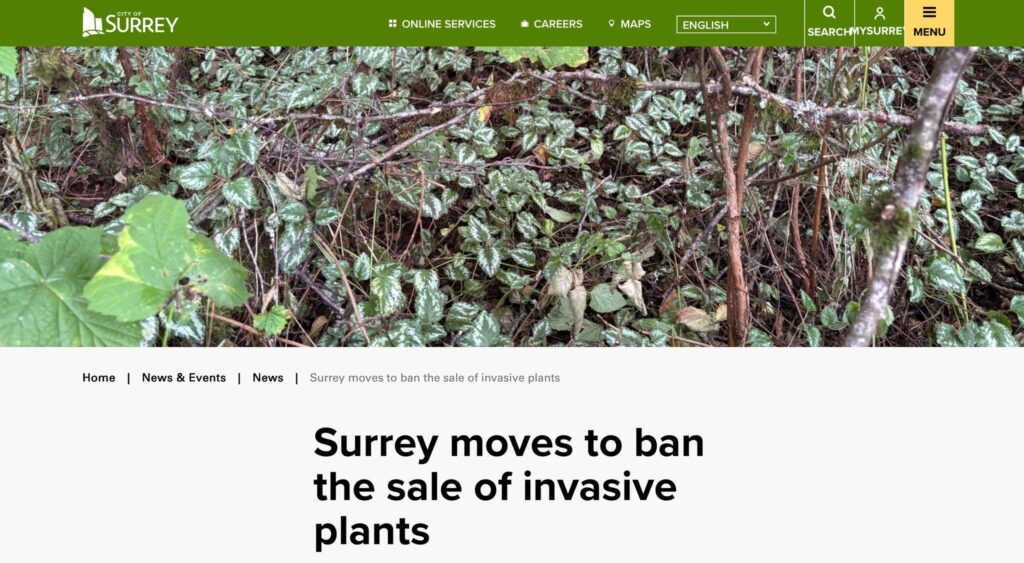
Surrey’s council has passed its ban, but it is not yet in force. On July 27, 2026, council gave third reading to Business License By-law, 1999, No. 13680, Amendment Bylaw, 2026, No. 22115. It would add that “no person carrying on a business shall sell to any person, offer for sale, or display any invasive plant species.”
Agricultural crops, food and dead plant material are exempt. The public could comment until September 18, 2026. The bylaw now awaits the minister’s approval, which it needs before council can formally adopt it.
The proposed list combines the provincial Spheres list with the Invasive Species Council of Metro Vancouver’s regional priority list. Because the regional list goes beyond the provincial one, the bylaw needs ministerial approval, which staff estimated would take three to six months, so a decision could come soon. The proposed fine is $500.
Notably, staff surveyed local retailers, including a box store, a greenhouse nursery, an aquarium supplier and a florist, and confirmed that invasive species are actively sold in Surrey today.
Nanaimo
On July 20, 2026, Nanaimo council directed staff to bring forward Business Licence Bylaw amendments restricting the sale and distribution of invasive plants such as Himalayan blackberry, English ivy, Scotch broom, English hawthorn, gorse, spurge laurel and Japanese knotweed.
Encouragingly, staff found that about 75 per cent of the 12 local retailers they contacted already had internal policies against selling invasive plants. It will be interesting to see how Nanaimo’s bylaw takes shape.
ONE REGION, FIVE SETS OF RULES
None of these approaches is wrong. But a gardener moving from Squamish to Surrey would face a different list, different rules and different penalties for the same plant, sometimes within an hour’s drive.
The Squamish-Lillooet Regional District shows how tangled this can get within a single region. All of its communities pay into one regional invasive species service, yet there are five sets of rules. Squamish and Whistler ban the sale of plants on the provincial list; Lillooet bans many more. I found no ban in Pemberton. And the rural areas in between fall under the regional district’s Noxious Weeds Control Bylaw, which uses yet another list and requires control but bans no sales. So butterfly bush can legally be sold in the town of Squamish, because it isn’t on the provincial list. Drive a few minutes out of town and the same shrub is a “noxious weed” that must not be planted. Even there, though, nothing stops anyone from selling it.
WHAT INDUSTRY SAYS
The nursery trade is watching closely. Coreen Rodger Berrisford, Executive Director of the BC Landscape & Nursery Association (BCLNA), discussed Surrey’s proposal with Stephen Quinn on CBC Radio’s The Early Edition (August 6, 2026). Her message, as I heard it, was less about opposing Surrey’s sales ban than about wanting consistency:
- Too many lists. There are many lists, built with different criteria and expertise. One municipality says one thing and the next says another. People don’t shop only in their own neighbourhood, so a ban in Surrey but not in Burnaby sends confusing messages to consumers and retailers alike.
- Robust, consistent lists. The industry wants lists it can rely on, consistent from place to place, including a watch list for plants whose risk may grow with climate change.
- Prioritize the highest risk. A phased approach should start with the highest-risk plants. For deeply entrenched species such as English holly, Himalayan blackberry and invasive morning glory, sales bans matter less. As she noted, no one is really selling those, and what is needed is removal from the landscape, which is a different strategy.
- Sales bans and shoppers’ choices. She was cautious about banning sales, though she allowed that bans may be important for some plants. Her main emphasis was on gardeners and shoppers making the right choices.
- Education and alternatives. She favours a broader educational approach, with staff training, resources and policy, and supports the Invasive Species Council of BC’s Recognized Retailer program. She called for updating the Grow Me Instead resources, now 10 to 15 years old, and noted that nurseries need to stock the alternatives. Retailer responses are mixed: some are engaged, while others lack the expertise.
- An opportunity to collaborate. She framed the moment as a chance to work together and strengthen environmental stewardship.
I am paraphrasing from my listening notes; please listen to the full conversation for a fuller picture.
I find this encouraging. On the central point, industry and advocates agree: a patchwork of local lists serves no one. The nursery association wants consistency because its members sell across municipal lines. CCIPR wants consistency because plants spread across them.
Where we might differ is on carrots versus sticks. Education and recognition programs matter, and Nanaimo’s experience shows that many retailers are already ahead of the law. But voluntary programs can’t reach every seller, and the most damaging plants deserve more than a carrot. A single, science-based list, applied consistently and with legal backing, would give responsible retailers the level playing field they need.
FINAL THOUGHT
In some ways, BC reflects the whole country. The Province is operating with antiquated weed control laws, and there has been a long reluctance to regulate the horticultural trade. With the industry favouring voluntary approaches, the Province has left it to local governments to act. This has led to an odd patchwork of lists and regulations, leaving the public and industry scratching their heads. This is why CCIPR is calling for a shared, science-based plant risk database and mandatory risk screening. While it shouldn’t be left to each town to act alone, it is encouraging to see more and more communities recognize that the best prevention begins at the head of the pathway.
In Part 3, I step back to ask what all this means across jurisdictions.
SOURCES
LEGISLATION AND BYLAWS
British Columbia. (2003). Community Charter, SBC 2003, c. 26, ss. 8–9. https://www.bclaws.gov.bc.ca/civix/document/id/complete/statreg/03026_00
British Columbia. (2004). Spheres of Concurrent Jurisdiction – Environment and Wildlife Regulation, B.C. Reg. 144/2004 (as amended to B.C. Reg. 155/2024). https://www.bclaws.gov.bc.ca/civix/document/id/complete/statreg/144_2004
District of Squamish. (2021). Invasive Species Management Bylaw No. 2786, 2020. https://squamish.civicweb.net/document/197714/
City of Chilliwack. (2021, consolidated 2023). Community Standards Bylaw 2021, No. 5041. https://www.chilliwack.com/…/attachments/attachView.cfm…
Resort Municipality of Whistler. (2025). Environmental Protection Bylaw No. 2426, 2025. https://www.whistler.ca/wp-content/uploads/BYL002426.pdf
District of Lillooet. (2026). Invasive Species Management Bylaw No. 2026-034. https://lillooet.civicweb.net/document/101484/
Squamish-Lillooet Regional District. (2017). Invasive Species Management and Control Service Establishment Bylaw No. 1541-2017. https://slrd.civicweb.net/document/100562/
Squamish-Lillooet Regional District. (2018). Noxious Weeds Control Bylaw No. 1542-2018. https://slrd.civicweb.net/document/100563/
MUNICIPAL REPORTS AND NEWS
CBC Radio, The Early Edition with Stephen Quinn. (2026, August 6). Surrey proposes ban on sale of invasive plants [Interview with Coreen Rodger Berrisford, BC Landscape & Nursery Association].
City of Chilliwack. (n.d.). Invasive species. https://www.chilliwack.com/main/page.cfm?id=2491
City of Surrey. (2026, May 20). Environment and Climate Change Committee minutes. https://www.surrey.ca/…/minutes/MIN-ECCC-2026-05-20.pdf
City of Surrey. (2026, July 23). Corporate Report R179: Invasive species sale ban. https://www.surrey.ca/…/corporate-reports/CR_2026-R179.pdf
City of Surrey. (2026). Notice of business license amendment: Bylaw No. 22115. https://www.surrey.ca/…/documents/Notice_BYL22115.pdf
City of Surrey. (2026, July 29). Surrey moves to ban the sale of invasive plants [News release].
CHLY. (2026, July 27). The Chttps://www.chly.ca/local-news/2026/07/27/the-city-of-nanaimo-gets-to-the-root-of-ongoing-invasive-plants-issue-with-bylaw-amendmentity of Nanaimo gets to the root of ongoing invasive plants issue with bylaw amendment.
District of Lillooet. (2026). Invasive Species Management Bylaw information. https://www.lillooet.ca/invasive-species-management-bylaw
Sea to Sky Invasive Species Council. (n.d.). Bylaws. https://ssisc.ca/bylaws
PROVINCIAL GUIDANCE
British Columbia Ministry of Municipal Affairs and Housing. (2017, October). A guide to local government actions requiring approval by the Province. https://www2.gov.bc.ca/assets/gov/british-columbians-our-governments/local-governments/governance-powers/guide_to_local_government_actions_requiring_approval_by_province_october_2017.pdf