Originally published on the CCIPR Facebook group, October 2, 2026
From Manitoba, we move on to the next two Prairie provinces to see how they regulate invasive plants.
Together, Alberta and Saskatchewan account for more than 70% of Canada’s total farm area: 32.0% and 39.2% respectively in the 2021 Census of Agriculture (Statistics Canada, Canadian Agriculture at a Glance: Saskatchewan; Alberta).
Protecting agriculture is therefore, understandably, a primary objective of provincial weed legislation. However, both provinces have expanded their regulations to include invasive plants that affect other sectors of the economy, the environment and public health. Because the two provinces share historical regulatory roots, this first post covers that shared history and described the regulatory system in Alberta. In Part 2, I will continue with Saskatchewan and compare the two. (Sorry this is a bit longwinded).
A long history of weed regulation
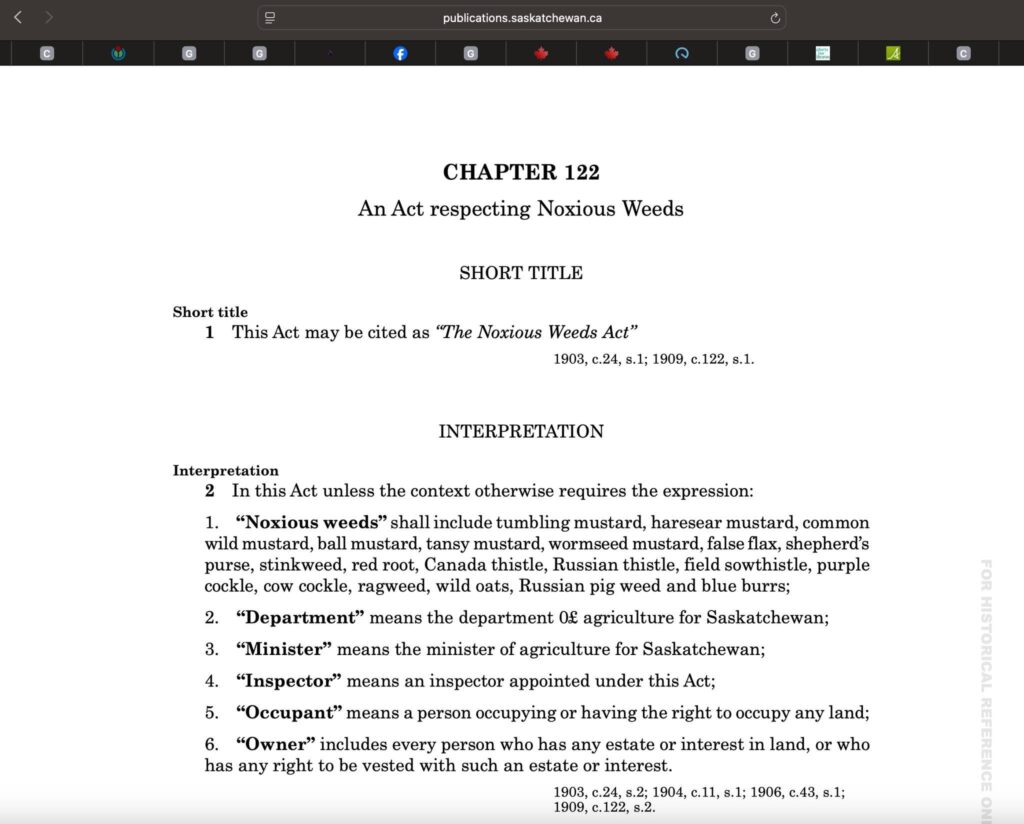
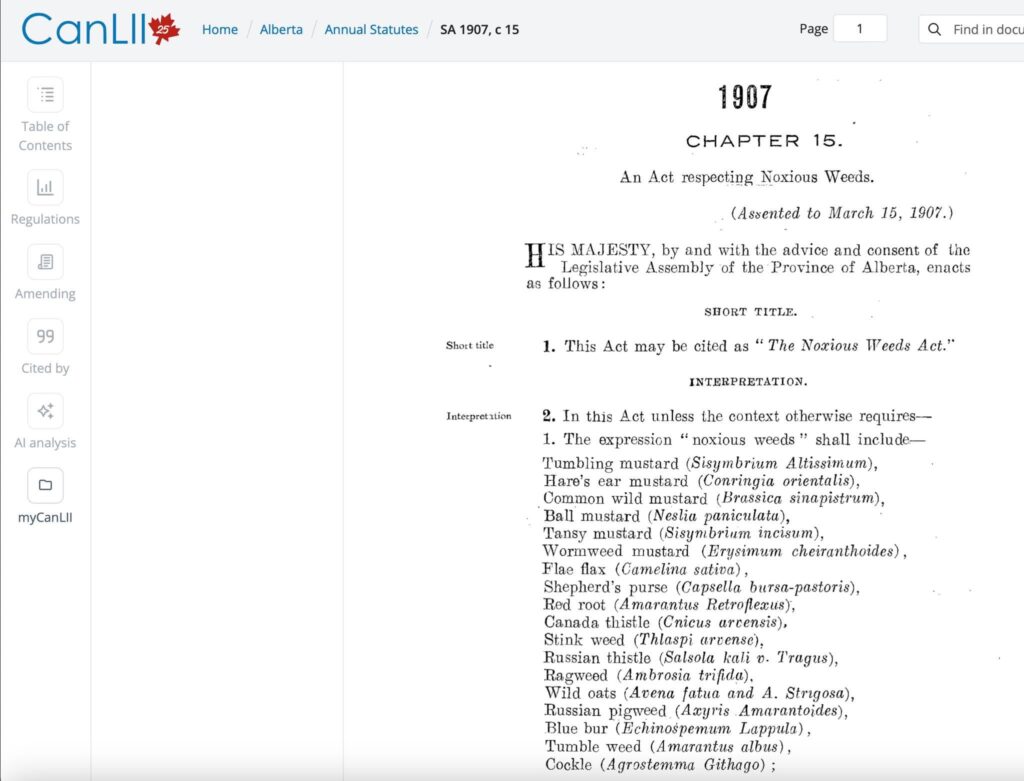
Preventing the introduction and spread of weeds predates Alberta and Saskatchewan becoming provinces. In the late 1800s, the North-West Territories enacted noxious weed ordinances that required the destruction of specific plants and established weed districts and inspectors. Those ordinances remained when the two provinces entered Confederation in 1905, until Alberta passed An Act respecting Noxious Weeds in 1907 (SA 1907, c 15), and Saskatchewan followed shortly after with its own version in 1909.
In that early period, the federal government was addressing related problems through a different pathway. The Seed Control Act (1905) restricted the sale of seed containing specified noxious weed seeds, protecting farmers and home gardeners from contaminated or poor-quality seed. The Destructive Insect and Pest Act (1910) aimed to reduce the spread of agricultural pests and diseases through the movement of nursery stock. Rather than delegating enforcement to local bodies, the federal government screened commodities and regulated trade directly.
This began a separation of responsibility that still matters today: provinces managed weeds growing on the landscape, while federal legislation addressed certain risks associated with the importation and sale of plants and seeds. (I will discuss my limited understanding of the evolution of federal legislation in a later post.)
From statutory mandates to enabling legislation
The early acts were direct statutory mandates. The weeds were named in the text of the statute itself (tumbling mustard, stinkweed and wild oats, for example), inspectors were appointed under the Act, and landowners were required to act; if they did not, inspectors were empowered to do the work themselves.
Over the twentieth century, the provincial acts became enabling legislation. Both provinces still set out lists of noxious weeds, but now it is done with a separate regulation or ministerial order rather than within the primary statute. The provinces then empower local authorities to enforce the law, and the provinces act as regulators of last resort.
From agricultural weeds to invasive plants
Along with shifts in responsibility have come shifts in the type of plants requiring control. While provincial weed legislation remains strongly focused on protecting agriculture, both Alberta and Saskatchewan recognize that introduced plants can harm forests, wetlands, waterways, urban property and other non-agricultural areas, and both have retooled their legislation to better address these concerns.
However, the number of plants requiring action has made weed control legislation somewhat unwieldy and resource-limited as I will discuss in posts to follow.
Next, in Part 2, I look at how Alberta regulates invasive plants today.
Sources
Legislation
- Alberta. (1907). An Act respecting Noxious Weeds, SA 1907, c 15. https://www.canlii.org/…/sa…/latest/sa-1907-c-15.html
- Canada. (1905). The Seed Control Act, 1905. Biodiversity Heritage Library. https://www.biodiversitylibrary.org/item/187072
- Canada. (1910). The Destructive Insect and Pest Act. HathiTrust. https://babel.hathitrust.org/cgi/pt?id=aeu.ark:/13960/t9378zv2d&seq=1
- North-West Territories. Ordinances of the North-West Territories. Internet Archive. https://archive.org/…/abl…/ableg_33398004181458_djvu.txt
- Saskatchewan. (1909). An Act respecting Noxious Weeds, RSS 1909, c 122. https://publications.saskatchewan.ca/#/products/85672
Other sources
- St. Pierre, M., & McComb, M. (2022). Alberta has the highest farm operating revenues in Canada. Canadian Agriculture at a Glance (Catalogue no. 96-325-X). Statistics Canada. https://www150.statcan.gc.ca/…/article/00009-eng.htm
- St. Pierre, M., & Mhlanga, S. (2022). Saskatchewan continues to live up to the title of breadbasket of Canada. Canadian Agriculture at a Glance (Catalogue no. 96-325-X). Statistics Canada. https://www150.statcan.gc.ca/…/article/00008-eng.htm
- Willing, T. N. (1900). Noxious weeds and how to destroy them. Regina. HathiTrust. https://catalog.hathitrust.org/Record/100315081